What Foam Lines Reveal About Depth and Food Delivery
I’ll help you read foam lines as moving clues to depth, current seams, and submerged structure. You’ll learn what drifting bubbles, brief pauses, and convergence points can reveal—and how to avoid mistaking surface foam for a guaranteed trout lie.
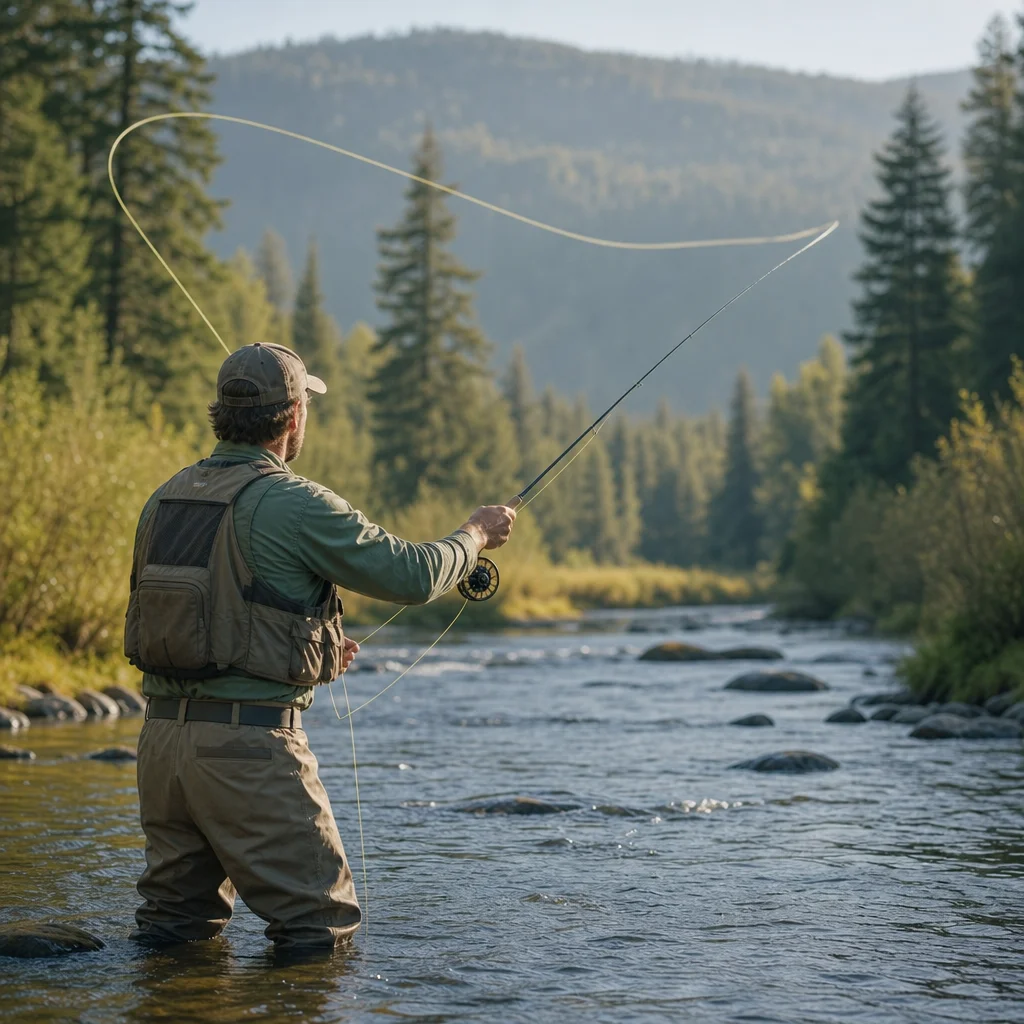
Foam lines can make a river look as though someone drew a useful map across its surface. They often collect where currents meet, slow, sink, or redirect around submerged features. But a foam line isn’t automatically a trout lie, and treating every visible bubble trail as a perfect target is one of the easiest ways to waste casts.
Used carefully, foam helps you build a working picture of the water below. Its speed, direction, pauses, and shape can reveal current seams, changes in depth, and places where food is likely to gather or pass within reach of feeding trout.
Start by watching the foam, not casting at it
Give the river a little time before you step into a cast. Pick one or two pieces of foam, leaves, or other harmless surface debris and follow them with your eyes. Notice where they travel quickly, where they slow, and whether they join a larger line.
This first observation answers a basic question: is the surface moving as one current, or are several currents sharing the same stretch of water?
A long, steady foam line usually marks a boundary or transport lane. Water on one side may be moving faster than water on the other. The difference can come from a change in channel width, a submerged rock shelf, a bend, an entering current, or a deeper trough.
The visible line is useful because it gives you a reference. Instead of guessing where the current changes, you can compare the foam’s movement with the water around it.
What foam speed can tell you about depth
Foam speed is a clue, not a depth gauge. Still, it can help you form a reasonable first estimate.
When foam moves rapidly across a shallow-looking section, the current may be pushed through a narrow channel or over a relatively uniform bed. Fast surface travel doesn’t always mean shallow water; a deep chute can also carry water quickly. Look for supporting signs such as a steep gradient, a constricted bank, or a smooth, accelerating surface.
When foam slows or lingers, the water may be deeper, wider, or affected by a back eddy. A pool tailout, the inside of a bend, or the area behind a submerged obstruction can all create slower travel. Slower foam often identifies a place where food remains available longer, but it doesn’t prove that trout are holding there.
A useful comparison is to watch foam on both sides of a line. If one side moves briskly while the other barely advances, the slower side may be a softer holding lane beside faster water. Trout can use that contrast to conserve energy while staying close to drifting food.
Look for changes, not just absolute speed
A foam line that changes speed over a short distance is often more informative than one that moves at a constant pace. Watch for these transitions:
- Foam accelerates as it enters a narrow chute.
- Foam slows beside a bank, rock, or submerged ledge.
- Foam spreads apart over uneven or recirculating water.
- Foam gathers into a tighter line where currents converge.
- Foam disappears briefly and reappears farther downstream.
The last example deserves caution. A short disappearance may indicate that the surface current has been diverted or that bubbles are being drawn below the surface. It can suggest a change in depth or a submerged feature, but the exact feature is hidden. Treat the spot as a question to investigate rather than a confirmed lie.
Pauses often point to soft water or structure
A foam fragment that pauses while nearby debris continues downstream is showing you a local change in current. The cause may be a small eddy, a depression, a rock, a root wad, or a seam where opposing flows meet.
Repeated pauses are more valuable than a single pause. If several pieces of foam stop in approximately the same area, the current pattern is probably stable enough to matter. A single leaf can catch on something insignificant; a consistent collection of debris suggests a broader feature.
Watch what happens after the pause. Foam may:
- Drift back upstream briefly.
- Rotate in a small circle.
- Slide sideways before rejoining the main flow.
- Sink from view and emerge downstream.
- Break apart and spread across slower water.
Each behavior describes a different kind of movement. A visible back-and-forth rotation points toward an eddy. A sideways slide may mark the edge of a seam. A disappearance and reappearance can indicate a submerged path or turbulence that carries material below the surface.
For fishing purposes, the most useful area is often the transition around the pause—not necessarily the center of the foam collection. Trout may hold where slower water meets food-bearing current, allowing them to feed without sitting in the strongest flow.
Convergence points concentrate information and food
A convergence point is where two or more surface flows come together. You may see separate foam lines merge, loose bubbles collect into one track, or debris from different directions funnel toward the same downstream path.
These locations matter for two reasons. First, they reveal the meeting of current tongues. Second, they may concentrate drifting insects, dislodged material, and other food. A trout doesn’t need the foam itself; it benefits from the delivery system represented by the foam.
Look upstream from the convergence point. One current may come from the main channel, while another enters from a side channel, bank, riffle, or pocket behind structure. The trout-holding water may be just downstream of the meeting point, along the softer edge of the combined flow.
The best target is rarely the most obvious white patch. Instead, identify the path food is likely to follow and the depth where a trout could intercept it. That might be:
- The near edge of a fast foam line.
- The downstream side of a submerged rock.
- A deeper lane beside a shallow riffle.
- The seam below an entering current.
- A slow pocket immediately next to moving water.
Common mistakes when reading foam lines
Mistake 1: Casting directly at the foam
Foam is easy to see, so it attracts immediate attention. But the line may be in the fastest water, while trout are holding just outside it. A cast placed directly on the foam can drag quickly, pull your fly out of the feeding lane, or land too close to a fish.
Instead, compare the foam with adjacent water. Start by targeting the boundary where the food-bearing current meets a slower lane.
Mistake 2: Assuming the foam marks the deepest water
Surface material can collect in shallow eddies, behind small rocks, or along irregular banks. A foam patch may reveal reduced surface speed without revealing substantial depth.
Use other clues to test the idea: darker color, a smooth surface over a drop, a change in wave texture, submerged structure, or a visible transition from shallow water. One clue is a starting point; several matching clues make a stronger case.
Mistake 3: Reading the surface without following it upstream
A foam line tells you where material is traveling, but not always where it came from. If you only examine the downstream end, you may miss the current that creates the pattern.
Trace the line upstream as far as you can. Find where separate flows begin, where the line first forms, and where it changes direction. This often reveals the actual seam more clearly than the foam’s largest concentration.
Mistake 4: Treating every pause as a trout lie
A pause can indicate structure, but structure alone doesn’t guarantee feeding fish. The water may be too shallow, too turbulent, poorly connected to food, or difficult for a trout to use efficiently.
Give priority to pauses that sit beside a reliable food lane and offer a reasonable holding depth. A small pause next to steady delivery can be more promising than a large, isolated collection of bubbles.
Mistake 5: Ignoring the wind and surface disturbance
Wind can push foam independently of the subsurface current. Turbulence can also move bubbles in ways that don’t match the main flow below.
Compare foam with heavier or partially submerged debris, such as leaves or small twigs, when available. Watch the surface from more than one angle. If the pattern changes dramatically with your viewing position, wind or glare may be exaggerating what you think you see.
Turn foam observations into a fishing plan
Once you’ve identified a likely seam or structure, decide how the fly should travel through it. The goal is usually not simply to reach the foam. You want the fly to enter the feeding lane with enough depth and drift control to look available.
First, estimate the direction of the current on each side of the line. Then choose a position that gives you a manageable cast and keeps the line from crossing faster water too soon. A shorter cast with better control is often more useful than a long cast that lands across several conflicting currents.
Begin with the most accessible part of the seam. If the foam line runs along a bank, work the near edge before reaching across it. If two currents converge, test the downstream shoulder and then the softer water beside the main flow. Change depth or presentation only after you’ve given the water a fair, controlled drift.
If the fly repeatedly swings, accelerates, or drags as it reaches the foam, the surface pattern may be telling you that multiple currents are involved. Adjust your position, mend earlier, shorten the cast, or select a different entry point rather than blaming the fly immediately.
Check the whole drift before moving: Follow your fly and the foam together from entry to exit. The most useful target is the section where the fly can remain in a plausible feeding lane, not simply the place where the bubbles are most visible.
A simple foam-line checklist
Before casting, ask:
- Where does the foam begin?
- Does it move steadily, slow down, or rotate?
- Which side of the line is faster?
- Do separate foam paths converge?
- Is there evidence of depth or structure beyond the foam itself?
- Where would food leave the main current and become easier to intercept?
- Can you make the fly drift through that area without crossing conflicting currents?
If you can answer most of these questions, you’re no longer casting at a white streak. You’re using the streak to build a model of the water.
Practical next steps
The next time you reach a river, spend one minute watching foam before choosing a target. Follow at least two pieces of debris, trace one line upstream, and identify one speed change or convergence point. Then make a short, controlled cast to the edge of the likely feeding lane.
Keep testing your interpretation against the drift. Foam can reveal how the surface is organized, but the fly’s behavior confirms whether that information is useful at fishing depth. Read the bubbles, check the surrounding water, and let the current—not the brightest patch of foam—choose your first cast.