Read a Trout Pool From the Bank Before You Wade In
A trout pool often reveals its feeding lanes, depth changes, fish positions, and safest entry points before you touch the water. I’ll show you a minimalist bank-side sequence for turning those clues into a quieter, more deliberate wade.
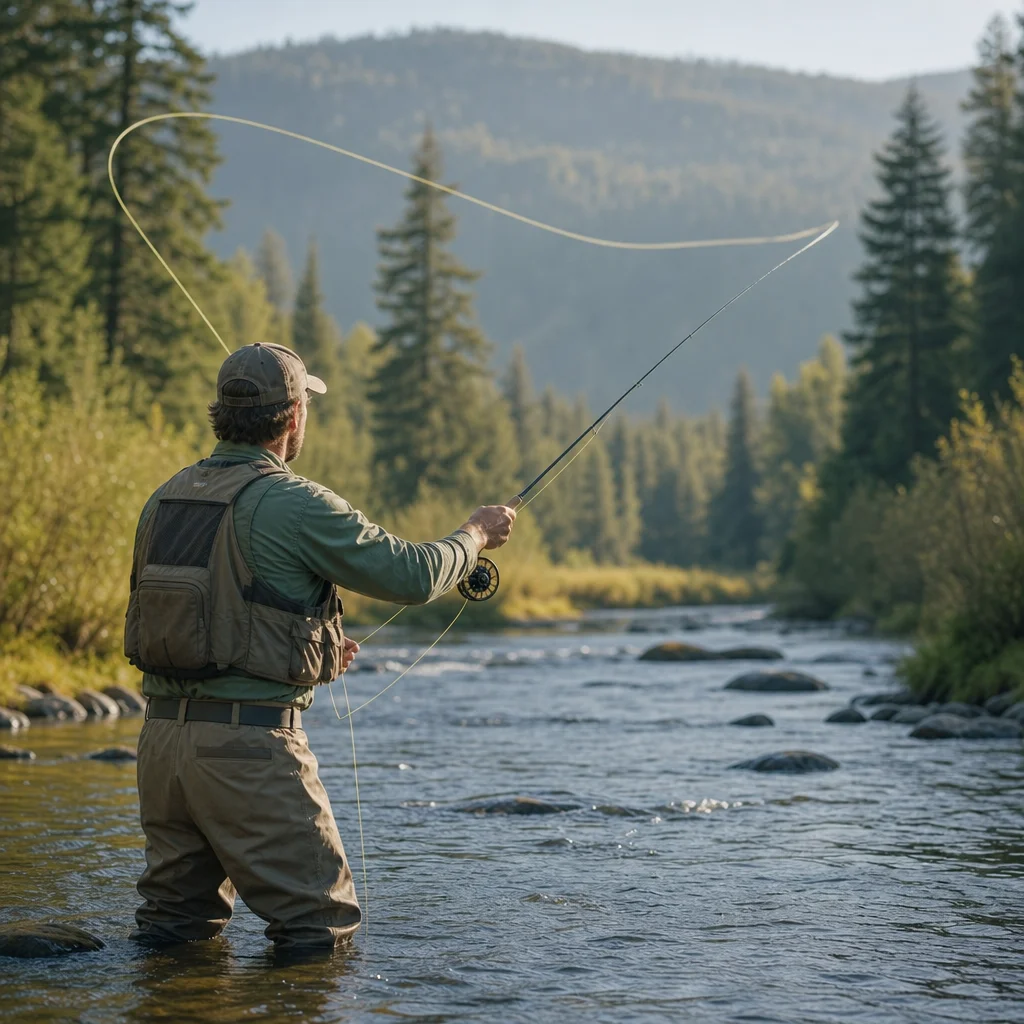
The first few minutes beside a trout pool can tell you where to fish and where not to step. Instead of wading straight to the spot that looks promising, use the bank to study current seams, depth, surface activity, and your route into the water.
You don’t need elaborate equipment for this. Polarized glasses, a pair of binoculars if the pool is large, and a willingness to stand still will do most of the work. The goal isn’t to identify every trout. It’s to understand the pool well enough that your first steps and first casts disturb as little as possible.
Start With the Whole Pool
Before focusing on individual features, take in the pool from bank to bank. Look at its shape, current speed, surface texture, and likely exits for fish. Give your eyes time to adjust; trout are easier to miss when you scan too quickly.
Work through the pool in broad sections:
- The head, where faster water enters
- The central body, where depth and current often vary
- The tailout, where water shallows and accelerates toward the next run
- The near bank, including any cover or undercut edges
- The far bank, if you can study it without climbing into an unsafe position
You’re looking for places where food can arrive without requiring a trout to spend more energy than it gains. Those places commonly occur near changes in current speed, depth, bottom texture, or cover.
Don’t assume the deepest-looking water holds every fish. Deep water can provide security, but feeding trout may be positioned on a shallow shelf, beside a seam, or just above a drop where drifting food collects.
Find the Feeding Lanes
A feeding lane is a path through the current where food can drift within reach of a trout. It may be visible as a narrow strip of smoother water, a line of bubbles, or a subtle change in surface speed.
Read the surface first
Watch leaves, foam, bubbles, and other small debris. Follow each item for several seconds rather than tracking only one piece. If several objects move along the same path, you’ve found a useful clue about the current.
Notice where the surface changes:
- A smooth strip beside broken water may mark a current seam.
- A line of bubbles can reveal a continuous drift lane.
- A glassy patch below a riffle may cover deeper water.
- Small whirlpools can indicate eddies where food circles or slows.
- A sudden change in surface texture may mark a submerged shelf or boulder.
The visible surface is only part of the picture. A trout may hold slightly inside the seam rather than directly in the fastest water. Fish can face into the current while remaining in a lower-speed cushion behind a rock, in a depression, or along the edge of a faster flow.
Watch for repeated rises
One rise may be an insect, a piece of debris, or a fish feeding only briefly. Repeated rises in the same area are more useful. Watch for a few minutes and note whether fish rise on a regular rhythm or appear at changing points along a lane.
A trout that rises repeatedly gives you more than a location. It also offers information about drift direction and timing. If the fish is taking from the surface, the food is likely moving into its position along a predictable path. If you see flashes below the surface without a clear rise, fish may be feeding on subsurface food.
Avoid walking closer simply to confirm what you saw. Start with the best information available from the bank.
Estimate Depth and Bottom Changes
Depth changes affect both trout position and your eventual wading route. Look for signs that the bottom rises or drops:
- A color change from pale to dark water
- A visible gravel shelf beside a darker trough
- A line where the current accelerates
- Standing waves over shallow rocks
- A slower, darker pocket beside fast water
- The edge of a submerged bank or drop-off
Water color can be misleading because light, cloud cover, and bottom material change its appearance. Treat color as a clue, not a measurement.
If you can see the bottom, observe how clearly. Clear visibility may indicate shallower water, but it can also make fish more wary. In slightly deeper or broken water, trout may be harder to see even when they’re close to the surface.
Look for the transition between shallow and deep water rather than concentrating only on the deepest section. Trout often use the edge because it gives them access to food moving through shallow water and the security of nearby depth.
Locate Fish Without Chasing Them
Once you’ve identified likely lanes and depth changes, search for fish in the places that combine food, manageable current, and cover.
Check the edges of current seams
A trout may hold just inside slower water while watching the faster lane. Its position can be difficult to see because the seam distorts the surface and breaks up the fish’s outline. Look for a stationary shadow, a brief flash, or a shape that stays in place while debris moves past.
Inspect cover and structure
Boulders, woody debris, undercut banks, and submerged ledges can provide shelter from current and overhead threats. Fish may hold behind or beside structure rather than directly under it. Study both the upstream and downstream sides, but don’t assume every piece of cover is occupied.
Search the tailout carefully
The tailout is often easier to overlook because it looks shallow and open. Fish may use it when food is moving toward the next run, particularly where a deeper section narrows into a steady flow. It can also be a sensitive area: shallow water gives fish less visual cover, so a careless approach may clear it quickly.
Use your eyes in stages
Scan near water first, then the middle distance, then farther across the pool. This helps separate the fish from the background. Polarized glasses can reduce glare, but they won’t make every trout visible. Change your angle slightly instead of leaning over the bank or waving the glasses around.
Plan the Entry Point Before You Move
The best entry point isn’t necessarily the closest one. Choose a place that lets you reach your intended water with the fewest steps and least disturbance.
Look for:
- A gradual, stable bank
- Shallow water with visible footing
- Firm gravel rather than loose silt or slick rock
- A route that stays downstream or to the side of likely fish positions
- Enough room to put on or adjust gear without crowding the bank
- A clear way back out
Avoid entering through the head of the pool if doing so requires crossing the main feeding lanes. Avoid walking across shallow tailouts when those shallows are likely holding fish. If the bank is undercut, unstable, or heavily vegetated, find another route rather than forcing a short approach.
Your entry plan should also account for casting room. A convenient landing spot that places your back against brush or forces you to cast over wading anglers may not be a useful one.
Check Your Wading Route
Before stepping in, confirm the current conditions, access rules, weather, and the footing you can actually see. Start in the shallowest manageable water, keep your route short, and turn back if the bottom or current feels less stable than it looked from shore.
Use a Simple Bank-Side Sequence
When you reach a new pool, follow the same compact routine:
- Pause at the bank. Give the pool a few quiet minutes before moving.
- Map the shape. Identify the head, body, tailout, near bank, and far bank.
- Track surface clues. Follow bubbles, leaves, and foam to find current paths.
- Mark depth changes. Note shelves, troughs, seams, and the edges of fast water.
- Search for fish. Look for repeated rises, flashes, shadows, and stationary shapes.
- Choose a first target. Pick one lane or feature rather than casting randomly.
- Plan the entry. Select the least disruptive route with the safest footing.
- Enter slowly. Stop after the first few steps and reassess what changed.
That last step matters. Fish may become visible once you’re lower to the water, while your movement may also have pushed them away. Treat the pool as a changing picture, not a diagram you solved permanently from the bank.
Keep the Minimalist Approach
It’s tempting to add more casts, more movement, and more equipment when a pool is difficult to read. Usually, the better response is to slow down and improve the quality of your observations.
You can make useful decisions with four questions:
- Where is food most likely to travel?
- Where can a trout hold without fighting the strongest current?
- Which fish or lane can you reach without crossing other likely holding water?
- Where can you enter and exit without compromising your footing?
If you can answer those questions, you have enough information to begin. You don’t need to see every fish or predict every current change.
Your Next Visit
At the next pool, delay your first cast until you’ve completed the sequence. Watch the surface, identify one depth transition, locate the most likely feeding lane, and choose an entry point that keeps you away from it.
Then make a quiet first approach and reassess after each step. The bank has already given you a plan; your job is to preserve the conditions that made the plan possible.