Find Trout at the Seam Between Fast and Slow Water
When fast current meets softer water, trout often gather where food and shelter overlap rather than anywhere along the bank. I’ll show you how to read that seam, choose its depth and drift lane, and fish the most promising water first.
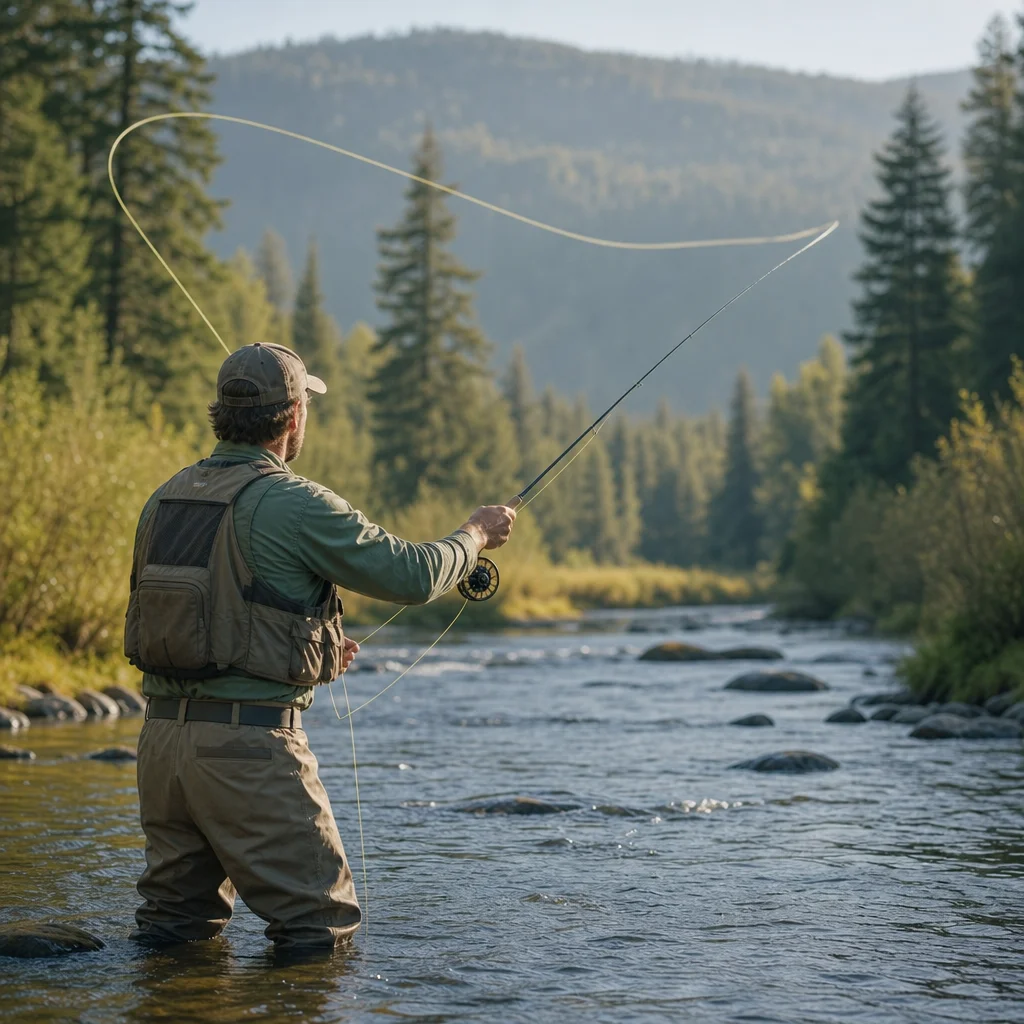
Why the seam attracts trout
A current seam forms where two flows move at different speeds or in different directions. You’ll often see it as a faint line between broken, fast water and a smoother tongue, but the important feature is beneath the surface: the seam combines food delivery with reduced swimming effort.
Fast water carries nymphs, drowned insects, and other food toward the trout. Slower water gives the fish a place to hold without spending as much energy. A trout positioned just inside the softer edge can watch food arrive from the faster flow, move a short distance to eat, and return to its holding position.
That balance is why a seam can be more valuable than a broad stretch of attractive-looking current. You aren’t simply looking for water that looks “fishy.” You’re looking for the intersection of food, shelter, and manageable effort.
Learn to see the whole seam
The visible line on the surface is only a starting point. A seam usually has several parts:
- The fast side: Water with more turbulence and delivery power. It may carry food, but it can be expensive for a trout to occupy.
- The soft side: Slower water where a trout can rest or feed with less effort.
- The transition zone: The most useful area to investigate first. Current speed changes here, and food may collect or pass close enough for a fish to intercept.
- The downstream tail: As the two flows merge, the current may become smoother and narrower. Trout sometimes use this area, especially when food is concentrated there.
Look for changes in surface texture rather than a perfectly straight border. A seam may appear as a line of foam, a difference in riffle pattern, a slick beside broken water, or a gentle crease where two tongues meet. In deeper water, the surface may reveal very little. Use nearby clues such as exposed rocks, submerged shelves, a bend in the channel, or a darker strip that suggests depth.
The best seam may not be the most obvious one. A large, dramatic meeting of currents can be too turbulent or too deep to fish effectively, while a modest crease beside a shallow riffle may offer trout a better feeding position.
Start by finding the soft edge
Begin on the slower side of the seam and work toward the faster water. This helps you avoid casting blindly across the entire current and gives you a useful question to answer: where can a trout hold comfortably while still reaching food?
Watch the surface for a few seconds before you cast. Follow foam, leaves, or bubbles as they drift downstream. If they accelerate immediately, you’re looking at the fast lane. If they stall, swirl, or move in a different direction, you may be seeing an eddy or softer holding water. The productive edge is often between those behaviors.
A trout may hold only a foot or two inside the slower water, particularly when the current is strong. In other conditions, the fish may sit slightly farther into the seam because the food is arriving there more consistently. Don’t assume the visible foam line marks the exact feeding position. Treat it as a reference point, then adjust based on the drift.
Find the right depth
Once you’ve identified the seam, determine where the current gives a trout both cover and access to food. Depth matters because the fish may not be suspended in the obvious surface flow.
In shallow riffle water, trout can feed close to the bottom while using rocks and uneven gravel as protection. In a deeper seam, they may hold beside a submerged ledge, in a trough, or near the bottom of the softer flow. The smoothest surface isn’t always the shallowest water, and the roughest surface doesn’t always mark the deepest channel.
A useful beginner’s approach is to divide the seam into three depth zones:
- The upper edge: Near the surface and close to the visible transition. This can be productive when trout are actively feeding or when insects are available in the upper water column.
- The middle seam: The zone where fast and slow flows overlap. This is often a strong starting point for nymphs and lightly weighted subsurface flies.
- The lower edge: Near the bottom or along a deeper boundary. Trout may use this area when the current is powerful, the water is cold, or surface feeding is limited.
Change one variable at a time. If your fly passes above the likely holding depth, add a little depth or improve your mend before abandoning the seam. If you repeatedly touch bottom, reduce weight, shorten the drift, or move your target slightly toward the softer water.
Choose a drift lane, not just a target
A good seam cast is less about dropping the fly on a single spot and more about placing it in a lane where it can travel naturally. Your goal is to keep the fly moving at roughly the same speed as the water around it.
Start with the lane nearest you. It usually requires less line, fewer mends, and less disturbance. A short, controlled drift along the soft edge can teach you more than a long cast across several current speeds. If the fly immediately swings, speeds up, or drags toward the bank, the cast may be covering the seam but not presenting naturally.
Then test the main transition lane. Cast slightly upstream of the area you want to fish and allow the fly to enter the seam before it reaches the suspected holding depth. Depending on your position, a small upstream mend may keep the fly from being pulled by the faster current. Avoid making large, repeated mends that slap the surface or move the fly unnaturally.
Finally, test the far side only if the near lanes produce nothing. A long cast across fast and slow water often creates conflicting drag. It may look impressive while giving the trout a fly that skates, stalls, or changes speed. Distance isn't automatically an advantage.
Match your approach to the current
The seam’s shape should influence your method.
For a surface presentation
Look for a soft edge where the surface is relatively smooth but food is entering from faster water. Present the fly upstream and slightly beyond the suspected feeding line. A high-floating pattern is easier to track, but a smaller or less visible fly may require you to watch the water around it for a subtle rise.
Keep your leader and line from crossing multiple current speeds when possible. A downstream belly in the line can pull the fly away from the seam before it finishes its drift.
For a nymph presentation
Focus on the seam’s depth and bottom contour. A nymph that is too shallow may pass above the fish, while one that is too heavy may snag constantly and interrupt the drift. Adjust weight, indicator depth, or leader length in small steps.
The most productive lane may be just inside the slower water, where the nymph receives food from the fast current without being swept through too quickly. In deeper seams, allow enough time for the fly to sink before it reaches the likely holding area.
For a swinging or streamered fly
A seam can provide a natural path for a fly moving from fast water into softer water. Begin with a controlled angle and observe how the current carries the fly. Trout may follow the boundary, strike as the fly slows, or hold near structure at the end of the swing.
Keep the presentation deliberate. If the fly rips across the seam, shorten the cast, change your angle, or use a downstream mend to slow its movement.
Avoid the common seam mistakes
Fishing the foam instead of the current. Foam can mark a useful line, but it can also collect in water with little food value. Watch how the surrounding water moves.
Covering every inch equally. Start with the soft edge, then the transition, then the deeper or faster boundary. Spend more time where the drift and holding conditions make sense.
Casting too far too soon. Long casts create more drag and make it harder to identify which lane is failing. Build outward from the water closest to you.
Changing flies before fixing the drift. If the fly is moving at the wrong speed or depth, a new pattern may not solve the real problem.
Wading into the target water. The seam closest to you may be the one you should fish first. Entering the river can disturb trout and remove the best presentation angle.
A simple seam-fishing sequence
Use this sequence whenever you find a promising meeting of currents:
- Watch the surface and identify the fast flow, soft flow, and transition.
- Look for structure or depth changes near the transition.
- Fish the nearest soft edge before making a longer cast.
- Start with a short drift and check the fly’s speed and depth.
- Adjust one variable—angle, mend, depth, or weight—before changing everything.
- Move through the middle seam and then the deeper or faster edge.
- Leave the seam if several natural drifts cover its useful lanes without a response.
A seam is productive because it solves a trout’s basic problem: how to find food without spending more energy than the meal is worth. Once you learn to identify that trade-off, you can stop treating the river as an equal patchwork of water.
On your next outing, pick one seam and map it mentally from bank to bank. Find its soft edge, trace the likely depth, and fish the drift lanes in order. A careful presentation through the right few feet will usually teach you more than repeated casts across the entire current.