Finding Trout in Fast Water When Every Current Looks the Same
I’ll compare the main ways to read a fast riffle—current speed, depth, structure, and seam lines—so you can narrow a seemingly chaotic run into manageable trout-holding zones and choose where to cast first.
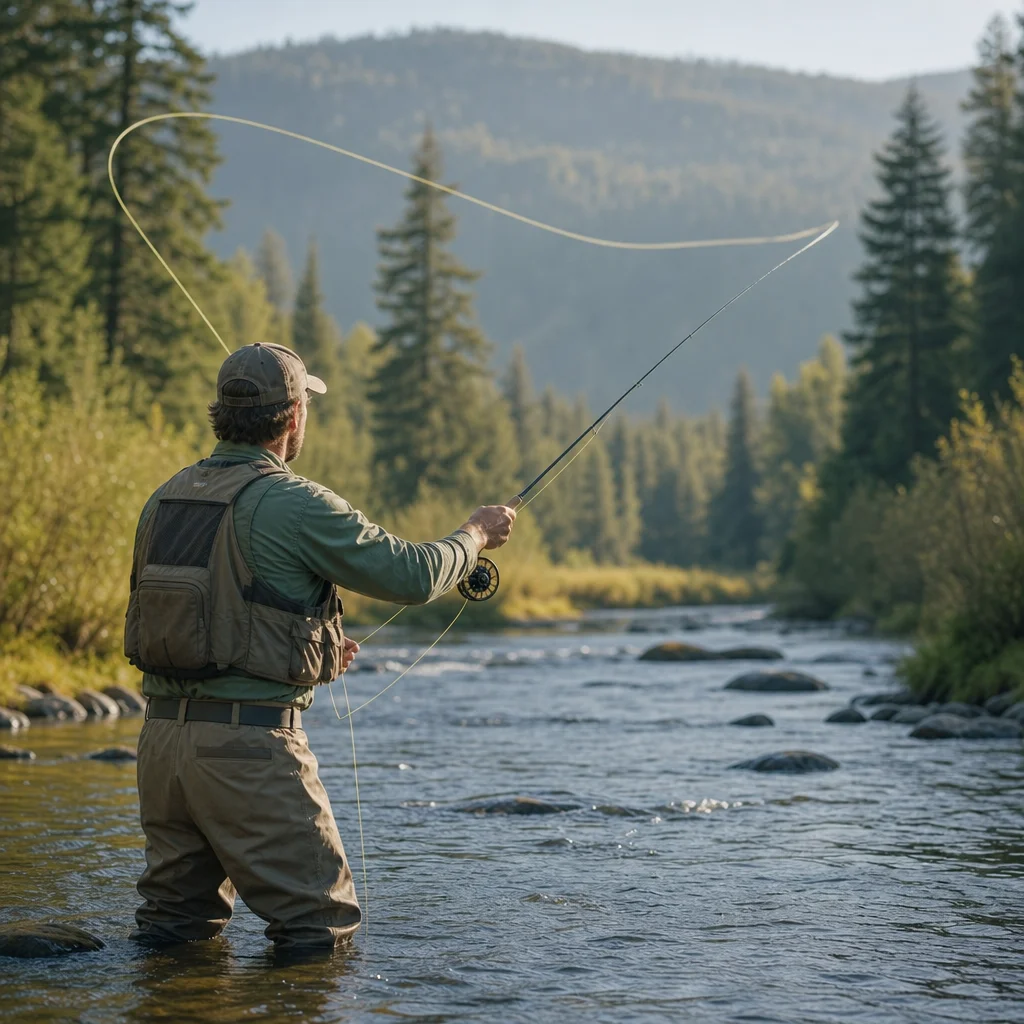
Fast water can make an entire run look equally promising—and equally impossible. Whitewater hides depth, riffles break your drift apart, and every rock seems to create another current line. The answer isn’t to search every square foot. It’s to divide the water into smaller zones and rank them by the conditions trout need.
In mountain streams, trout usually aren’t looking for the fastest water available. They’re looking for enough flow to deliver food, enough depth or cover to feel secure, and a manageable current that doesn’t waste more energy than the meal provides. Your job is to find where those needs overlap.
Start by reading the whole run
Before wading in, spend a minute looking at the water from a stable position. Don’t begin by focusing on the most obvious pocket. First identify the run’s basic shape:
- Where does shallow water enter?
- Where does the current slow or deepen?
- Which rocks, ledges, or banks interrupt the flow?
- Where do two currents meet?
- Where does the riffle transition into a pool or deeper glide?
Fast water is easier to understand when you treat it as a sequence rather than a single feature. Many riffles have an upstream feeding section, a broken middle section, and a slower tailout. Trout can occupy all three, but they may use them differently and require different presentations.
The surface gives you clues, not a complete answer. A smooth patch may be deep and powerful beneath the surface, while broken whitewater may be shallow enough to exclude larger fish. Look for changes in surface texture, foam movement, and the angle at which current lines travel downstream.
Break the riffle into manageable zones
A useful first division is to separate the run into five kinds of water: entry, pockets, seams, deeper lanes, and the tailout. These zones can overlap, but naming them helps you avoid casting randomly.
1. The entry zone
Where shallow water first spreads into a riffle, trout may hold along the edges of the incoming flow. The water can be oxygenated and food-rich, but the center is often too fast or too shallow for sustained holding.
Look for a slight trough, a darker strip, or a soft edge beside the fastest current. These subtle changes may be more important than a dramatic rock. Start with the water closest to you if it can be reached without disturbing the rest of the run.
2. Pocket water behind rocks
A boulder can create several useful positions, not just one. The obvious spot is the cushion of slower water immediately upstream of the rock. Trout may also hold in the pocket behind it, along either side, or in the seam where slower water meets the main flow.
The best position depends on depth and current speed. A shallow cushion may hold a small trout briefly, while a deeper pocket behind the rock can offer better shelter for a larger fish. Don’t assume the biggest visible rock is the best target. A low rock that creates a deeper slot may be more productive.
Approach these targets from downstream when possible. Cast to the upstream side first, then work the near edge, pocket, and downstream seam. One rock can require several drifts, each aimed at a different piece of water.
3. Current seams
A seam is the visible or subtle boundary between currents moving at different speeds or directions. It may look like a foam line, a narrow V, or a change from smooth to broken surface.
Seams are valuable because trout can hold in slower water while moving into faster water to feed. The exact holding position may be just inside the slow side, directly beneath the foam, or a short distance away where the current begins to deepen.
Avoid treating a seam as a line on the surface only. Follow it downstream and watch whether it remains connected to depth or structure. A long foam line over shallow gravel may be less useful than a short seam beside a deep bank or rock face.
4. Deeper lanes
Depth changes are often difficult to see in fast water, but they can be inferred. Look for darker water, reduced surface chop, a persistent bubble path, or a section where the current seems to travel smoothly while the surrounding water breaks.
A deeper lane may run beside the main riffle, through its center, or along one bank. Trout often favor the deepest available lane when water is bright, cold, or especially turbulent, but they may move into shallower water when food is concentrated there.
When you find a likely deep lane, don’t immediately wade toward it. Test the water within casting range first. Many anglers cross productive water to reach a target and then wonder why the target has gone quiet.
5. The tailout
The lower end of a riffle usually becomes slower, smoother, and more uniform. This transition can be overlooked because it lacks the drama of pocket water, but it often provides a clear change in depth and current speed.
Search the head of the tailout first, where faster water delivers food into a deeper glide. Then examine the edges and any narrow seams that continue downstream. Trout may move through the riffle and settle here when they want less current pressure.
Tailouts can also be sensitive areas. Their smooth surface makes fish easier to spook, so longer leaders, quieter movement, and a downstream or quartering presentation may matter more than adding distance to the cast.
Use hydraulics to rank your targets
You don’t need to calculate water velocity to use hydraulics effectively. Think in terms of three questions:
- Where is the current strongest?
- Where can a trout escape that current?
- Where does food pass between those two areas?
A trout rarely needs to sit in the fastest flow to feed from it. More often, it holds in a slower pocket, behind a rock, along a bank, or near the bottom of a deeper lane. The feeding opportunity is the nearby faster water.
This creates a simple priority system. Favor places that combine:
- A speed difference between holding water and feeding water
- Enough depth or cover for security
- A reliable food path
- A cast and drift you can control
If a location has only one of these traits, keep it in mind but don’t make it your first choice. A shallow seam may look perfect but offer little security. A deep pocket may look safe but receive almost no food. The strongest targets usually combine at least two or three advantages.
Read depth changes without seeing the bottom
Mountain streams often conceal their depth beneath glare and foam. Polarized glasses can help, but they won’t turn every riffle transparent. Instead, compare nearby water.
Darker water is often deeper, though shadows and reflections can mislead you. A change in surface texture may indicate a drop-off. If bubbles disappear briefly and reappear downstream, they may be passing over a depression or submerged structure. A bank that looks uniform above water may have a narrow undercut or submerged shelf below it.
Watch how your fly or indicator behaves in different lanes. If it rides high and fast in one section but slows or dips in another, the water may be deeper or hydraulically different. This is useful information, but don’t use repeated blind casts as your only depth-finding method. Start with visual clues and refine your estimate through careful observation.
Compare the near water before the far water
A common mistake is to cast across the entire run because the far seam looks more impressive. That approach often crosses several currents, creates drag, and requires unnecessary wading.
Work from near to far. Begin with the edge, then the nearest pocket, seam, or deeper lane. After covering those areas, extend the cast a little farther. This sequence protects fish close to you and gives you better control over the drift.
The same principle applies when wading. Enter through the shallowest, slowest route you can find, and avoid walking through likely holding water. Fast water can be deceptive: a crossing that looks manageable may contain uneven footing or a deeper slot. If you can’t clearly identify the bottom and your exit route, choose a different position rather than forcing the crossing.
Match your presentation to the zone
Fast water usually punishes a presentation that is too ambitious. Your first goal is a controlled drift, not maximum distance.
For pocket water, make short casts and keep the fly line off competing currents. For seams, aim slightly upstream of the target so the fly reaches the holding lane naturally. For deeper lanes, allow enough time for the fly to reach the likely depth, but avoid adding so much weight or length that you lose contact and snag repeatedly.
In a riffle, mending can help, but more mending isn’t automatically better. If the fly is moving too quickly, identify which current is pulling it. Then make the smallest mend that removes that influence. Large, repeated mends can move the fly away from the lane you worked to reach.
If surface visibility is poor, simplify your search. Fish one likely zone thoroughly before changing flies or moving across the stream. A missed drift caused by conflicting currents can look exactly like a fly-choice problem.
A practical order for fishing a complex riffle
Use this sequence when the water feels visually crowded:
- Observe the run from downstream without entering it.
- Identify the safest approach and the nearest likely holding water.
- Fish the near edge and any obvious pocket.
- Work seams beside rocks, banks, and current changes.
- Test deeper lanes and the head of the tailout.
- Reassess the water before moving farther or changing tactics.
After each drift, ask what you learned. Did the fly drag immediately? Did it slow in a particular lane? Did bubbles collect against a bank? Did your line indicate a deeper slot? These small observations turn a confusing riffle into a map.
Common mistakes to avoid
Chasing the biggest whitewater
The loudest water is easy to notice, but it may be too fast or shallow for a trout to hold comfortably. Search its edges, cushions, and downstream pockets instead.
Treating every seam as equally good
A seam matters because of what it connects. Prioritize seams beside depth, cover, or a dependable feeding lane.
Wading before thinking
Entering the water can scatter fish and erase your best angle. Study the run first, and make the closest useful cast before taking a step.
Changing flies too quickly
If your drift is dragging or riding at the wrong depth, a new fly may not solve the problem. Check current speed, mending, weight, and casting angle before blaming the pattern.
Ignoring the exit
Fast water deserves respect even when you’re focused on fish. Keep track of where you can safely leave the run, and don’t let a productive stretch pull you beyond a comfortable position.
Your next-riffle checklist
When every current looks the same, slow the decision down. Find the entry, pockets, seams, deeper lanes, and tailout. Then rank each target by the combination of speed change, depth, cover, and food delivery.
Start close, fish methodically, and let each drift teach you something about the water beneath the surface. Once you stop treating a riffle as one large problem, the currents become separate clues—and trout become much easier to find.