Improve Short-Range Accuracy by Casting Less Line
Short-range trout shots reward controlled line more than dramatic casting, especially on small streams and spring creeks. I’ll show you how compact strokes, deliberate targets, and simple line management can replace rushed false casts with repeatable accuracy.
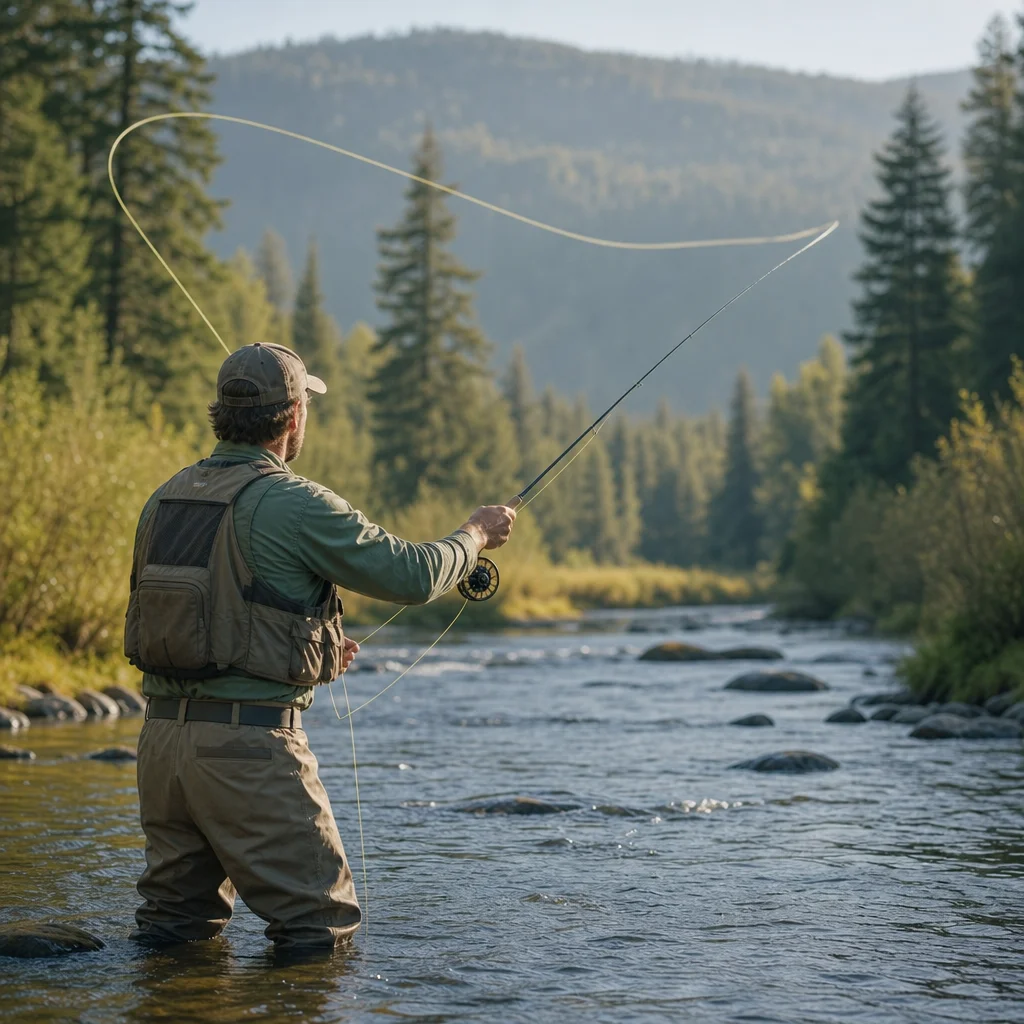
Short casts often become harder when you try to make them look like long casts. On a small stream, you may have only a few yards of line beyond the rod tip, a narrow window between branches, and a trout that won't wait while you organize everything. The usual response is to false cast faster or add more line. That often creates the very problems you’re trying to solve.
For close trout, accuracy usually improves when you cast less line, make smaller movements, and put more attention on the target. The goal isn’t to generate a beautiful loop at distance. It’s to deliver the fly quietly to a specific patch of water while keeping enough line under control for the next drift.
Why short-range casting gets messy
At close range, the fly line may already be near the length you need. Extra false casts don’t give you much useful distance, but they do give the fly more chances to land in a branch, brush a rock, or drag across the surface. They also encourage your casting arm to speed up without a clear reason.
Short-range problems commonly come from four habits:
- Carrying too much line in the air for the target.
- Using a long casting stroke meant for a longer cast.
- Watching the loop instead of fixing your attention on the landing point.
- Leaving loose line on the water where current can move it before the fly reaches the target.
There’s also a timing problem. With only a short amount of line outside the rod tip, the loop can straighten quickly. If you pause as though you’re casting a much longer line, the line may fall behind the rod or collapse. If you rush the next stroke, the loop often opens and loses direction.
The remedy isn't simply “cast faster.” It’s to match the stroke, pause, and line length to the small task in front of you.
Start by deciding what “short” means
Before lifting the line, identify the actual distance from the rod tip to the landing point. You may need only a rod length of fly line outside the tip, plus the leader. If the fly is already close enough, don’t add line just because you’re holding extra line in your casting hand.
A useful starting setup is:
- Hold only the line needed to reach the target and form a manageable loop.
- Keep the rod tip on the side of the stream that gives the fly a clear path.
- Pick a landing spot, not just a general direction.
- Make one controlled pickup and one forward delivery when possible.
That last point matters. A short presentation often works best as a single back cast followed by a forward cast. If the fly is in the wrong place, make another compact cycle rather than adding several decorative false casts.
You don’t need to eliminate false casting completely. A false cast can help you dry a fly, change direction, or adjust a small amount of line. The issue is using it automatically when the cast already has enough line to reach the target.
Build a compact casting stroke
A compact stroke is shorter than the motion you’d use for a long overhead cast, but it still has a clear stop. The rod hand moves through a small path, accelerates smoothly, and stops firmly enough to let the line straighten. Avoid trying to steer the fly through the entire motion with your hand.
Think of the cast in three parts:
- Lift: Raise the line cleanly from the water or grass without ripping it away.
- Short stroke: Move the rod through a controlled path with modest acceleration.
- Stop and wait: Let the line unroll before beginning the forward motion.
The pause may be brief. With short line, it’s often much shorter than a beginner expects. Watch the line’s movement out of the corner of your eye, but keep your attention primarily on the target. You’re looking for enough straightening to load the rod and organize the loop, not a long, dramatic pause.
If the line falls behind you before the forward stroke, shorten the pause. If the back loop never forms and the line feels tangled or heavy, slow the hand slightly and allow the rod to load before moving forward.
The stop should direct the loop, not force it. A hard jab tends to make the loop narrow unpredictably or throws the leader out of alignment. A soft, unfinished stop leaves the loop wide and the fly without enough control.
Aim at a landing point, not the trout
Trout are a poor visual target for a developing caster. They move, they may be partly hidden, and focusing on them can make you hurry. Choose a spot where the fly should land so the current carries it toward the likely holding water.
On a small stream, that spot might be:
- Just above the head of a pocket.
- Along the slower edge beside a faster tongue.
- A foot or two upstream of a visible rise.
- The quiet seam beside a rock or submerged branch.
The precise distance depends on the current, fly, leader, and presentation you’re trying to achieve. The general principle is steady: land the fly where the water can take it into the feeding lane without requiring a large mend immediately afterward.
For short casts, the difference between a good and poor result may be only a few inches. That’s why a specific target helps. “Near that rock” is vague. “The two-foot cushion above the rock” gives your casting motion a job.
Keep the line hand useful
Short-range accuracy doesn’t come from the rod hand alone. Your line hand controls how much line you carry, how quickly you can recover it, and how cleanly you can begin the next drift.
Before the cast, pinch the fly line lightly against the rod grip with the index finger of your rod hand or control it in the way you normally cast. Keep the free line hand organized rather than allowing coils to spill around your feet, reel, or pack.
After the fly lands, avoid stripping in more line than you need. Extra line creates slack that can be useful in some situations, but on a confined stream it can also catch current and pull the fly off course. Feed or recover line deliberately, based on the drift you want.
If you miss the target, resist the instinct to snatch the line off the water immediately. First ask whether the fly can still drift effectively. A cast that lands slightly short may be recoverable with a small feed. A cast that lands long may require a reset, but a quiet pickup is usually better than a frantic series of corrections.
Use roll casts and water-loaded casts when space is tight
Small streams often give you little room behind the rod. Trees, steep banks, and tall grass can make a normal back cast awkward or impossible. In those situations, a roll cast or another water-loaded cast may be more accurate than forcing an overhead loop.
Let a section of line and leader rest on the water in front of you. Form a controlled anchor to one side, then sweep the rod back and make a forward stroke toward the target. The anchor should be small and intentional. Too much line stuck to the surface creates excessive resistance; too little gives the cast nothing to load against.
A roll cast also helps you avoid lifting line high above wary fish. It won’t solve every close-range presentation problem, but it can replace a cramped back cast with a repeatable forward delivery.
Keep the motion compact here as well. A large sweep often moves the anchor, opens the loop, and sends the fly somewhere other than the place you chose.
Troubleshoot the common misses
The fly lands short
You may be carrying too little line, stopping the rod too early, or failing to let the line straighten behind you. Add only the amount of line needed to reach the target. Then make a slightly longer stroke or allow a fraction more time on the back cast.
Don’t immediately speed up. Speed without a completed loop usually makes the cast shorter and less stable.
The fly lands too far to one side
Check your casting plane. Your forward stroke may be traveling across your body, or your wrist may be rotating during the stop. Pick a line from the rod tip to the target and keep the stroke aligned with it.
On a narrow stream, even a small sideways error can put the fly in the wrong current. A shorter stroke with better alignment is more useful than a stronger stroke.
The leader piles up
A leader that collapses before the fly lands can result from an open loop, an overly soft stop, or too much slack in the system. Tighten the loop by improving the stop and carrying only the line required for the cast. Avoid trying to punch the leader straight with a sudden wrist movement.
The fly lands hard
A hard landing usually means the loop is too open, the cast is too forceful, or the final delivery is aimed directly at the water. Reduce the power and let the leader turn over toward the target. For a delicate presentation, the last part of the cast should have enough energy to straighten the leader but not enough to slap the fly down.
You keep false casting after a miss
Stop and reset. Repeated false casts often turn a small miss into poor line control, fatigue, or a fly caught in vegetation. Strip in enough line to regain a comfortable amount, identify the new target, and make one deliberate delivery.
A simple practice sequence
You can practice short-range accuracy without a stream or a fish. Place small markers at several close distances and cast to them using the minimum line needed for each one.
Start with one back cast and one forward cast. Then try changing direction by a small angle without adding line. Next, practice landing the fly just beyond a marker, then just to one side of it. Finish with a few roll casts if your fishing regularly involves bankside obstacles.
Between casts, ask three questions:
- Did I carry more line than the target required?
- Did my stop point the loop toward the landing spot?
- Was the line on the water organized for the next drift?
Those questions connect accuracy to fishing usefulness. A cast isn’t successful merely because the fly reaches the right patch of water; it also needs to leave you in control afterward.
Put the approach on the water
On your next small-stream outing, choose an easy target before approaching the best water. Use it to settle your timing and line hand. Try one compact false cast at most, then deliver the fly with the minimum line that works.
If the presentation misses, diagnose the specific error instead of adding speed or distance. Shorten the stroke, adjust the pause, change the target, or reset the line. With fewer moving parts, you’ll have a better chance of noticing which change actually improves the cast.
The practical sequence is simple: choose the landing point, carry less line, make a compact stroke, stop cleanly, and keep the loose line under control. On close trout water, that quiet sequence is often more accurate—and much less tiring—than trying to cast farther than the stream requires.