Fly-Fishing Terms You Actually Need to Know at the Shop and on the Stream
Fly-fishing vocabulary becomes useful when it helps you choose the right tackle and recognize what the water is telling you. I’ll translate the terms you’re most likely to hear at a fly shop and use on the stream.
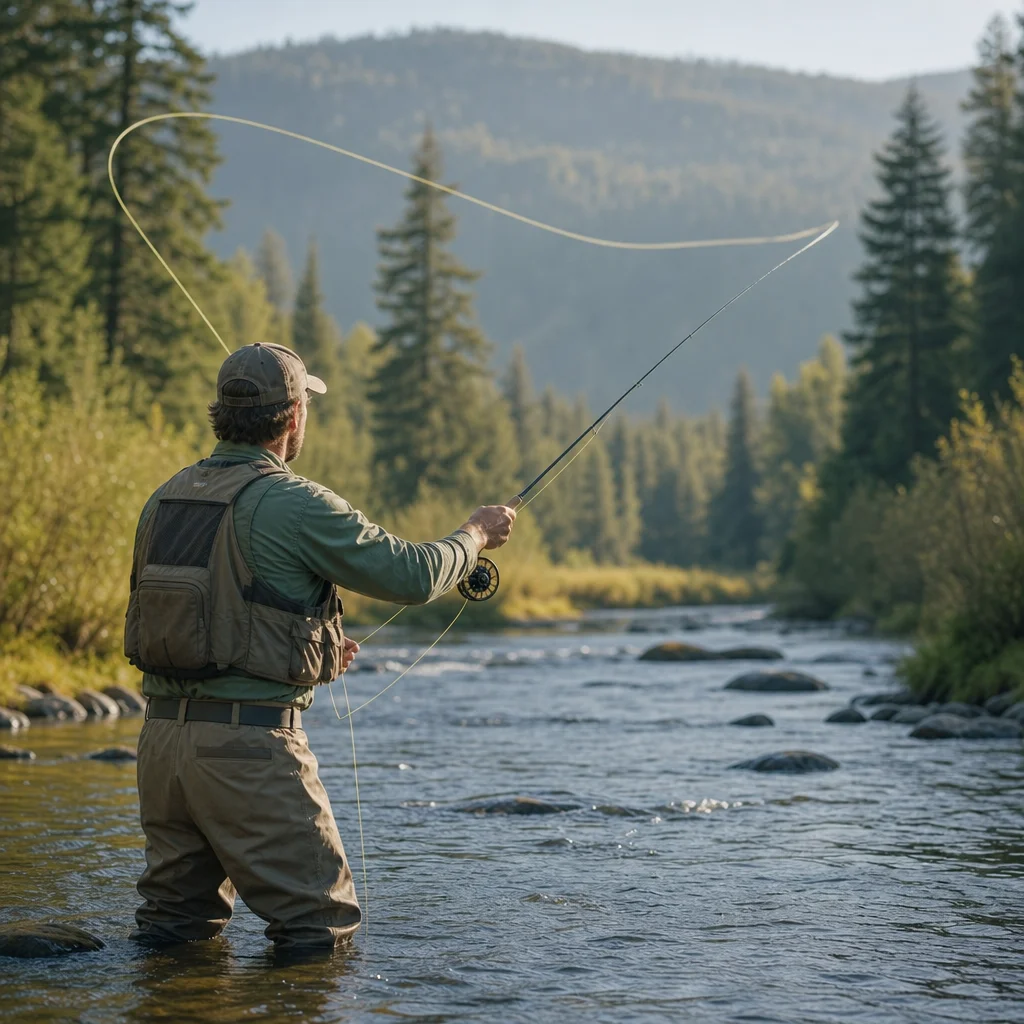
Walking into a fly shop can feel like arriving halfway through a conversation. Someone is discussing a five-weight, a nine-foot leader, a size 18 BWO, and the seam on the far bank—and all you wanted was a setup for trout.
You don’t need to memorize every term before you start fishing. You do need enough vocabulary to describe what you’re trying to do, understand basic advice, and avoid buying gear that doesn’t match your water or flies. The terms below are organized around the decisions you’ll make most often.
Rod and reel terms
Weight, length, and action
A fly rod’s weight, often written as weight-forward or simply 5 wt, describes the line it’s designed to cast. It doesn’t directly describe the rod’s physical weight. Common trout rods range from roughly 3 wt to 6 wt, with 4 wt and 5 wt setups serving many general freshwater situations.
- A 3 wt or 4 wt can make small flies and light tippets enjoyable on smaller water.
- A 5 wt is a versatile starting point for many trout streams and moderate-sized rivers.
- A 6 wt offers more power for larger flies, stronger wind, bigger fish, or heavier lines.
The best choice depends on the size of the water, typical flies, wind, and the strength of the tippet you expect to use. A heavier rod isn’t automatically better; it can make small-stream fishing feel clumsy. A lighter rod may struggle when you need to cast a weighted streamer or control a fish in strong current.
Length affects reach, line control, and maneuverability. A longer rod can help you mend line and keep more line off the water, while a shorter rod is easier to handle beneath trees or along tight banks.
Action describes how the rod bends and recovers.
- A fast-action rod bends more toward the tip and recovers quickly. It generally provides more casting power and performs well in wind, but it can feel less forgiving for a beginner.
- A medium-action rod bends farther down the blank and offers a balanced mix of feel and power.
- A slow-action rod bends deeply and loads easily at shorter distances. It can be pleasant for delicate presentations, though it may feel less efficient when casting far or punching through wind.
When comparing rods, ask how the action fits the fishing you’ll actually do—not just which rod has the most power.
Reel, arbor, and drag
The reel stores backing and fly line. For most trout fishing, it also provides a way to manage line and apply pressure to a fish, although your rod hand and the line itself often do much of the work.
The arbor is the central cylinder around which line is stored. A large-arbor reel retrieves line more quickly and reduces tight coils in the line. A smaller arbor can still work well, especially when weight and simplicity matter more than fast retrieval.
Backing is the thin line beneath your fly line. It fills the reel spool and gives a fish extra line if it runs farther than the fly line’s length. In many ordinary trout situations, you may never see the backing, but it should be attached correctly and kept in good condition.
The drag is the reel’s adjustable resistance. It helps control a running fish without relying entirely on your hand. Keep it light enough to protect fine tippet, and avoid assuming that a strong drag will solve every problem. Sudden pressure can break a thin connection quickly.
Fly-line terms that affect casting
Floating, sinking, and specialty lines
A floating line stays on or near the surface. It’s the standard choice for many trout anglers because it works with dry flies, nymphing techniques, and some streamers. It also makes line control and visual tracking easier.
A sinking line is designed to move below the surface. It can help reach deeper water with streamers, but it requires different casting habits and is less versatile for a new angler’s first setup.
An intermediate line sinks slowly and can be useful when you want a fly below the surface without taking it rapidly toward the bottom. Specialty lines may also have sinking tips or different densities along their length.
If you’re buying your first line, describe your usual water and flies before choosing a specialty option. A versatile floating line is often easier to learn with than a line designed for one narrow situation.
Weight-forward and double-taper lines
A weight-forward line, or WF line, has most of its casting weight concentrated toward the front. This design helps load the rod and carry line through wind or across longer distances. It’s a common all-around choice.
A double-taper line, or DT line, has a more gradual taper toward both ends. It can be pleasant for short, controlled casts and delicate presentations. Because either end can be used as the front, it may offer a practical way to extend the line’s useful life after reversing it.
The line’s weight should match the rod’s stated weight. A line that’s too light may not load the rod effectively; one that’s too heavy may make it feel sluggish or overload it during casting.
Running line, shooting head, and sink tip
A shooting head is a concentrated section of line designed to cast long distances with less false casting. It’s more common in specialized techniques than in a beginner’s general trout setup.
Running line is the thinner line behind a shooting head. It slides through the guides during a cast and helps the head travel farther.
A sink tip is a section of line that sinks while the rest of the line floats. It can put a streamer or nymph deeper without requiring a fully sinking line. Because it changes how the line behaves during pickup and casting, it’s best treated as a specific tool rather than a universal upgrade.
Leader and tippet vocabulary
Leader
The leader connects the thick end of the fly line to the fly. It is tapered, starting with a thicker butt section and narrowing toward the fly. That taper helps transfer energy from the cast and turn the fly over more naturally.
Leaders are commonly described by length and strength, such as a 9-foot 4X leader. A longer leader can help with cautious trout and clear water, but it also demands better casting and line control. A shorter leader can be easier to manage, particularly with larger flies or limited backcasting room.
Tippet
Tippet is the thin final section between the leader and the fly. You can tie on fresh tippet when the leader becomes shorter, damaged, or contaminated with knots.
Tippet is labeled with an X rating, such as 3X, 4X, or 6X. The number can be counterintuitive: as the X number increases, the diameter and breaking strength generally decrease. In simple terms, 6X is finer than 4X.
Use the tippet size that suits both the fly and the fish. Very fine tippet can improve a delicate presentation, but it is less forgiving around rocks, heavy flies, and strong fish. Very heavy tippet may make a small fly move unnaturally or land heavily.
When a shop employee asks what tippet you need, be ready to mention the fly size, water clarity, and species you’re targeting. “The smallest tippet available” is rarely the complete answer.
Fly terms you’ll hear most often
Dry flies, nymphs, streamers, and emergers
A dry fly floats on the surface. It imitates an adult insect, terrestrial insect, or another food item that trout can see from below. Trout rising repeatedly to the surface are often described as feeding on dries or rising.
A nymph imitates an immature aquatic insect below the surface. Nymphs are usually fished beneath an indicator, with a tight line, or as part of a specialized short-line technique.
A streamer is a larger, moving fly that imitates baitfish, leeches, crayfish, or other substantial prey. Streamers are commonly stripped, swung, or allowed to move with the current.
An emerger represents an insect moving from its underwater stage toward the surface. Emergers can be fished just below or within the surface film, where they may be difficult to see but attractive to trout.
A terrestrial imitates land-based food such as ants, beetles, grasshoppers, and crickets. These can become important when insects fall from streamside vegetation.
Hatch, match the hatch, and presentation
A hatch is a period when aquatic insects emerge in noticeable numbers. Anglers may say there’s a caddis hatch, mayfly hatch, or stonefly hatch, referring to the insect group—not necessarily a single exact species.
Match the hatch means choosing a fly that resembles the available food in size, shape, color, or behavior. It doesn’t mean an exact imitation is always required. Presentation—the way the fly moves and drifts—often matters just as much.
A fly’s profile is its overall outline. Size 14 or size 20 refers to the hook size, with larger numbers generally indicating smaller hooks. Because hook sizing varies among patterns and manufacturers, treat the number as a useful starting point rather than a perfect measurement.
Reading the water
Riffles, runs, pools, and flats
A riffle is shallow, broken water flowing over rocks or gravel. Riffles add oxygen and can provide feeding lanes, especially when the current delivers food into deeper water below.
A run is a section of relatively uniform current, usually deeper and smoother than a riffle but faster than a pool. Trout may hold along the bottom, behind structure, or where different currents meet.
A pool is deeper, slower water. The head of a pool, its deeper middle, and its tailout—the shallower downstream end—can all fish differently.
A flat is broad, relatively smooth water with little visible turbulence. Flats can make trout easier to spot but often make them more alert because your movement, shadow, and leader are easier to detect.
Seams, eddies, and holding water
A seam is the visible or subtle boundary between two currents. Food often collects along a seam, and trout can hold in slower water while watching faster water carry food toward them.
An eddy is a circular or reversing current, often found behind rocks, around bends, or near obstructions. It can gather foam and insects, but the changing current may make a natural drift difficult.
Holding water is any place where trout can rest and feed without spending more energy than they gain. Look for depth, current breaks, cover, and food—not just the most obvious dark patch of water.
A lie is the specific position where a fish is holding. Anglers may refer to a feeding lie, a resting lie, or a prime lie. The term is useful because it shifts your attention from “Where is the fish?” to “Where can the fish hold efficiently?”
Casting and presentation terms
False cast, roll cast, and back cast
A false cast is a cast made without letting the line land. You move the line back and forth in the air to change distance, dry a fly, or reposition the line. Too many false casts can create slack, disturb fish, and tire your arm, so use them for a reason.
A back cast is the portion of the cast that travels behind you. It loads the rod and sets up the forward cast. You need enough room behind you for the line to unfold; branches, tall grass, and other anglers can make a standard back cast impractical.
A roll cast uses the tension of the line on the water instead of a full back cast. It’s useful when obstacles prevent you from bringing the line behind you. It can also help lift and reposition line before another cast.
Mend, drift, and drag
To mend line means to reposition it on the water after the cast. An upstream mend can slow the fly’s downstream movement; a downstream mend can have the opposite effect. The correct mend depends on the current and the drift you’re trying to create.
A drift is the fly’s movement through the water. With a dead drift, the fly travels at roughly the speed of the surrounding current rather than being pulled by your line.
Drag occurs when the line or leader pulls the fly unnaturally. A dry fly may skate across the surface, or a nymph may move faster than nearby bubbles. Drag is one of the most common reasons a trout refuses an otherwise suitable fly.
A reach cast places the fly on one line while laying the rod and line in another direction. This introduces slack that can delay drag. It’s especially useful when the current between you and the fly is faster than the current carrying the fly.
Trout behavior and hook-setting terms
A trout that rises comes to the surface to take food. A head-and-tail rise may show the fish eating just below or within the surface film, while a splashier rise can indicate a more aggressive take or a different food position.
A subsurface take happens below the surface and may be detected through an indicator, a tightening line, a flash, or a change in the drift. Not every movement is a fish, but a suspicious pause or sideways shift deserves attention.
An indicator is a floating device used to suspend or track a subsurface fly. It can show depth and help you notice a take, but it can also add drag if it’s too large, too close to the fly, or poorly positioned.
To set the hook means moving the rod or line to drive the hook into the fish’s mouth. The motion should match the situation. A quick, controlled lift is often more appropriate for trout than a dramatic, forceful strike—particularly when using fine tippet or a small fly.
The vocabulary to use at the fly shop
You’ll get better advice if you describe conditions instead of asking only for “a good fly.” Mention:
- The species you’re targeting.
- The size and type of water you’ll fish.
- Whether the water is clear, stained, shallow, or deep.
- The flies you already have or expect to use.
- Whether you’re seeing rises, baitfish, insects, or no obvious activity.
- Your rod weight, line type, and leader setup.
A useful question might be: “I’m fishing a small, clear stream with a 4-weight floating line, and I’m seeing small trout rise in the evening. What leader and dry-fly sizes should I consider?” That gives the shop enough information to recommend something specific.
A short vocabulary checklist
Before your next trip, make sure you can explain these basics:
- Rod weight: the line class your rod is designed to cast.
- Floating line: a versatile line that stays on the surface.
- Leader and tippet: the tapered connection between line and fly.
- Fly type: dry fly, nymph, streamer, emerger, or terrestrial.
- Water feature: riffle, run, pool, seam, eddy, or tailout.
- Presentation problem: drag, poor drift, excess slack, or inadequate depth.
- Fishing response: whether trout are rising, holding deep, or moving toward a fly.
You don’t need fluent shop jargon to catch trout. Learn the terms that help you make a decision, then use the water to test that decision. If the fly is wrong, change it. If the drift is poor, improve the line control. If the fish are holding somewhere else, move your attention before buying another box of flies.