What Does a Trout Angler Actually Need to Know About Current
I’ll clarify how seams, cushions, soft edges, and downstream flow help you read a trout stream, so you can stop memorizing intimidating terms and start making sensible decisions about where to cast and how to recover when your first guess is wrong.
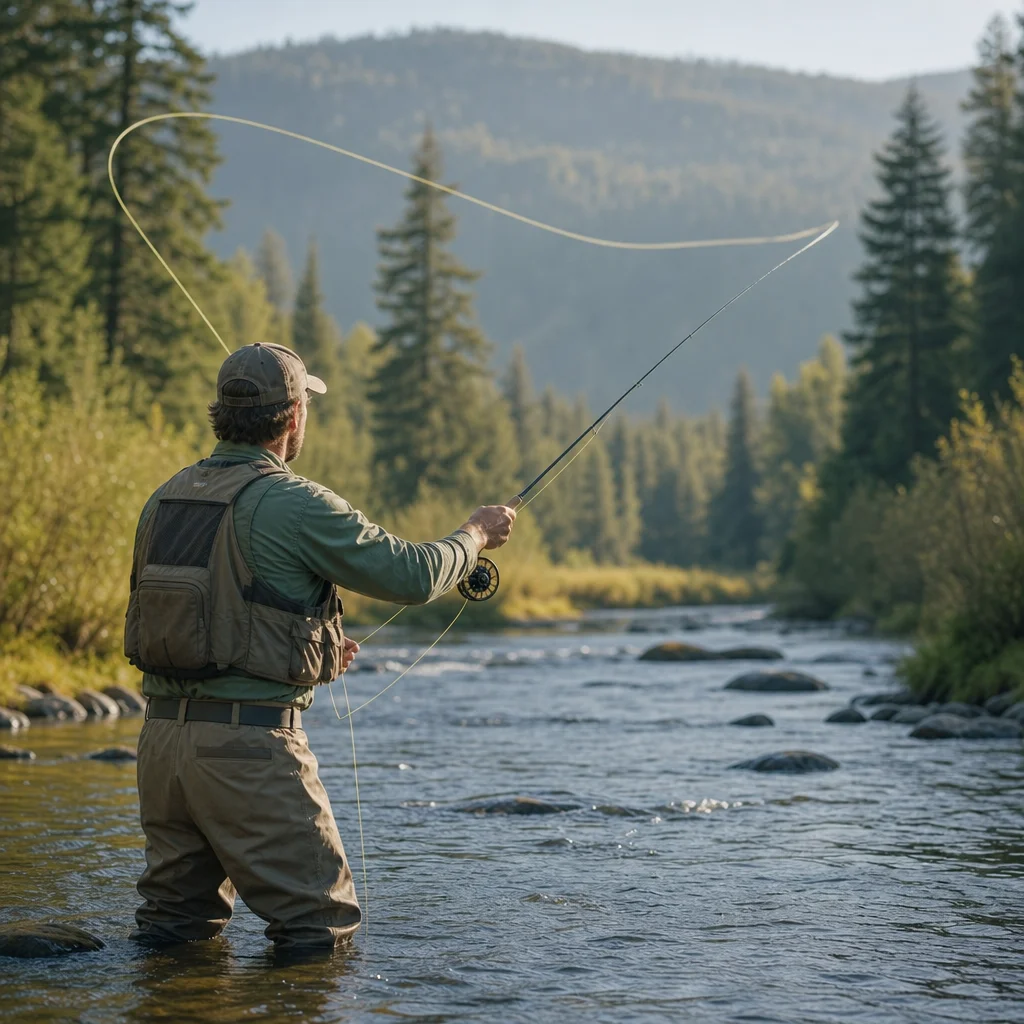
Current is the map trout use
When you look at a stream, it’s easy to see only moving water. Trout see a menu of feeding opportunities, shelter, and places where holding position costs less energy. Your job isn’t to memorize every current term. It’s to notice where water behaves differently and ask one useful question:
Where can a trout face into food-bearing water without fighting the strongest flow?
That question will lead you to most of the important features: seams, cushions, soft edges, and changes in downstream flow. They aren’t separate pieces of secret knowledge. They’re clues about speed, depth, turbulence, and available shelter.
Start by reading the whole current
Before choosing a fly or wading into position, watch the stream for a minute. Look at leaves, foam, bubbles, and bits of grass drifting on the surface. They reveal the direction and relative speed of the current more clearly than the water itself.
Then divide the water into broad categories:
- Fast water: Often carries plenty of food, but requires more energy for a trout to hold in.
- Slow water: Costs less energy to occupy, though it may receive less food or expose a fish more clearly.
- Broken water: Rocks, waves, and bubbles can hide a trout from predators and from you.
- Transition water: Places where fast and slow flows meet, often creating useful feeding lanes.
You don’t need an exact depth reading to begin. Look for changes. A smooth surface beside riffled water, a darker tongue entering a pool, or a quiet pocket behind a rock may be more informative than a dramatic-looking rapid.
What a seam really is
A seam is the boundary between two currents moving at different speeds or in different directions. You may see it as a line of foam, a change in surface texture, or a narrow strip where debris collects.
The water on either side may be moving at different speeds, while the seam itself can offer trout a convenient feeding lane. Food drifting in the faster water may be carried toward the slower side, where a trout can intercept it without holding in the strongest current.
A seam isn't always a sharp, tidy line. In a wide river, it may be several feet across. In a small creek, it may be no wider than your boot. Treat it as a zone rather than a painted stripe.
How to fish a seam
Try to identify three parts:
- The fast side, which may deliver food.
- The boundary, where food can collect or become easy to intercept.
- The slow side, where a trout may hold with less effort.
If you’re casting across the current, aim to place the fly where it can enter the seam naturally. The goal isn't merely to land on the visible line. The goal is to avoid dragging the fly across different speeds of water.
A useful first cast may be just upstream of the seam, allowing the fly to drift into the transition. If the fly immediately swings sideways or the leader pulls ahead of it, your cast or line position is creating drag. Adjust the angle, mend the line, or shorten the drift rather than repeatedly casting at the same spot.
Cushions form in front of obstacles
A cushion is the softer, pressured water immediately upstream of an obstacle such as a boulder, log, or large submerged ledge. The current pushes against the obstacle and loses some of its force before splitting around it.
From above, the cushion may look like a smooth patch or a small bulge in the surface. It isn’t necessarily still water. It’s simply less forceful than the main current approaching the obstacle.
Trout may use this area because it offers two benefits:
- The obstacle provides cover.
- The reduced current makes holding position easier.
A large trout may sit near the front or sides of a cushion, while smaller fish may use nearby pockets. The most obvious whitewater behind the rock isn't always the best target. Start with the quieter water in front of or beside the obstacle, then work outward if needed.
Watch the shape of the cushion
Cushions are often easiest to recognize when you compare the water around them. If the current is smooth and fast upstream, then suddenly rises, wrinkles, or slows before a rock, you’re probably looking at a cushion.
The exact holding position changes with water level and flow strength. A fish that sits close to a rock during moderate flow may move farther behind it when the current becomes stronger. After rain or a significant change in flow, reassess the structure rather than assuming yesterday’s position still applies.
Soft edges are quieter borders
A soft edge is the slower water along the bank or beside a faster channel. It can occur where the current rubs against a bank, where vegetation interrupts the flow, or where a shallow margin meets deeper water.
These edges are easy to overlook because they may not look dramatic. Anglers often focus on the middle of a channel and walk past the water closest to their feet. That’s a good way to spook the trout you meant to catch.
Soft edges can provide:
- Lower current speed.
- Nearby depth or overhead cover.
- Access to food carried along the faster water.
- A relatively easy route for small aquatic insects and other prey.
Look for a narrow strip where bubbles move more slowly than those in the main current. Also check the downstream side of banks, roots, undercut edges, and grass that reaches into the water. Fish may hold directly along the border or a short distance into the slower water.
Approach these areas carefully. Keep a low profile, avoid stepping into the target water, and make your first cast from farther away than feels necessary. The fish may be closer to you than the opposite bank, which isn't a reason to give it a closer look with your boot.
Downstream flow tells you where food travels
Downstream flow is the overall movement of water toward lower ground. It sounds obvious, but new anglers often notice only the surface direction and miss how current changes around depth, rocks, bends, and channels.
A fly drifting downstream should travel at roughly the same speed as the water around it. If the fly moves faster than nearby bubbles, the current is pulling your line or leader. If it lags behind, slack or a slower current is interfering. Either problem can make a trout reject the presentation.
The flow also tells you how to search a stretch systematically. Begin with features that interrupt or soften the current, then follow the water downstream to see what those features create:
- A rock may produce a cushion upstream and a slower pocket downstream.
- A bend may push faster water toward one bank and create a soft edge on the other.
- A shallow riffle may feed a deeper pool through a seam.
- A fallen branch may split the current into several small lanes.
Think of each feature as part of a connected system, not an isolated target.
Match the feature to your first cast
Once you’ve identified a likely holding area, choose a cast that protects the drift. Your first cast should usually be the easiest, least disruptive presentation—not the longest or most ambitious one.
For a seam
Cast slightly upstream of the area where you expect a trout to hold. Keep the line off conflicting currents when possible. A reach cast, an upstream mend, or a shorter drift can help the fly follow the seam instead of cutting across it.
For a cushion
Present the fly from upstream or from the side, depending on access and cover. Keep the cast compact around rocks and avoid repeatedly hitting the obstacle itself. A fly that lands softly near the edge of the cushion is more useful than one that lands perfectly in the loudest water and immediately drags away.
For a soft edge
Cast parallel to the bank or slightly into the slower water. Watch your feet before moving. If the target is close, a short roll cast or carefully placed lift may be better than a full back cast that catches branches, grass, or your own enthusiasm.
For a downstream transition
Look for where fast water enters slower water, such as the head of a pool or the tail below a riffle. Trout may hold just inside the slower section, facing into the incoming flow. A controlled upstream presentation can allow the fly to enter that lane naturally.
Troubleshoot the drift before changing flies
When a likely spot produces nothing, the fly may not be the first problem. Current can make a good fly look unnatural before it has traveled a few feet.
Use the drift as evidence:
| What you see | Likely current problem | First adjustment |
|---|---|---|
| The fly skates sideways | It is crossing currents | Change your casting angle or mend sooner |
| The leader straightens immediately | The line is pulling the fly | Keep more line upstream or reduce slack in the wrong place |
| The fly stops while bubbles continue | It is caught in slower water | Shorten the drift or reposition to match the lane |
| The fly sinks unevenly | Currents are affecting the leader | Reduce excess leader on the surface or change the presentation angle |
| The fly drifts well but gets no response | The holding spot or fly may be wrong | Try an adjacent current feature before changing everything |
This process helps you separate a presentation problem from a location problem. Change one variable at a time when conditions allow. Otherwise, you won’t know whether the fish ignored the fly, never saw it, or saw a line dragging it through the current like a tiny boat with poor steering.
Read water from downstream when you can
Approaching from downstream often gives you a better view of current lines and keeps your body behind the fish’s likely field of vision. It also encourages casts that travel upstream, which can produce a natural drift and reduce the amount of line lying in faster water.
This isn’t a rule for every situation. Wind, steep banks, dense brush, deep pools, and the direction of your quarry may make another approach better. The broader principle is to observe before disturbing the water and to enter the stream only when you have a reason.
Check Your Crossing Plan
Before stepping into moving water, assess depth, footing, current speed, and an exit route. Avoid crossing if the water is beyond your confidence or conditions are changing, and follow local access and safety requirements for the specific river or stream.
Wading can turn a promising fishing position into a difficult one quickly. If you can reach a seam or soft edge from the bank, that is often the better choice.
A simple routine for unfamiliar water
Use this sequence when you arrive at a new stretch:
- Stand back and watch. Note surface bubbles, foam lines, and changes in texture.
- Find the strongest flow. Then look immediately beside it for slower water.
- Mark the transitions. Seams, cushions, and soft edges are your first search areas.
- Look for cover. Rocks, depth, shade, undercut banks, and vegetation can make a current feature more attractive.
- Choose the safest approach. Prefer a bank position or shallow access that doesn’t disturb the target water.
- Make one controlled cast. Judge the drift before deciding it failed.
- Troubleshoot the current. Adjust angle, line, or position before abandoning the feature.
- Move methodically. Cover the near water first, then work toward farther targets.
You won’t always see a trout, and you won’t always get the current exactly right. The routine still gives you a repeatable way to make decisions instead of casting at every patch of water that looks vaguely fish-shaped.
The useful version of current knowledge
You don’t need to label every piece of a river. You need to recognize differences in speed and understand what those differences offer a trout.
- Seams are boundaries between currents and common feeding lanes.
- Cushions are softer water in front of obstacles.
- Soft edges are slower borders beside faster flow.
- Downstream flow connects these features and carries food through them.
On your next outing, pick one feature and observe how the water moves through it. Make a careful presentation, watch the drift, and adjust only after you understand what the current is doing. That habit will take you farther than memorizing a long list of river vocabulary.