Where Trout Hold When a River Has Too Much Perfect-Looking Water
I’ll clarify how to find trout when a river seems to offer endless, identical water. You’ll learn how to compare depth, current speed, cover, and feeding value so you can fish fewer, better targets instead of covering every yard.
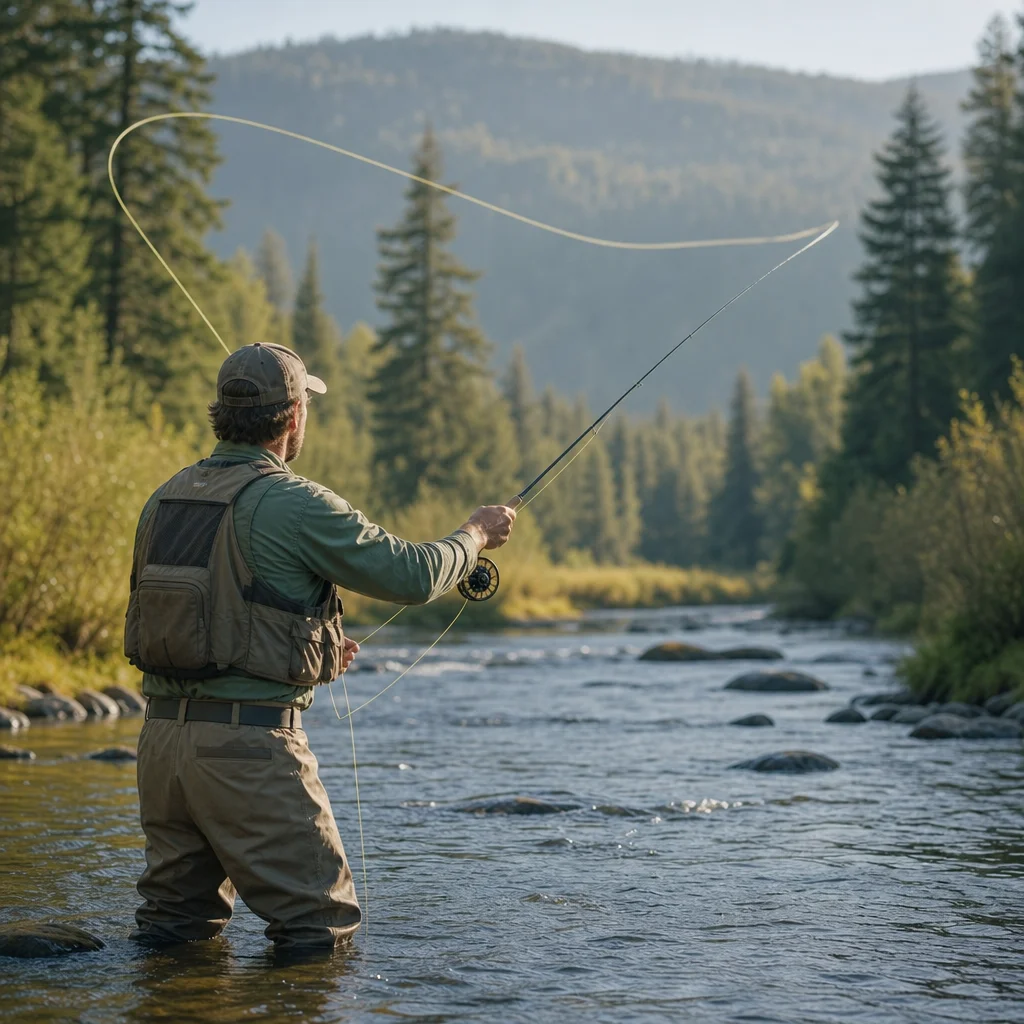
When a river is broad, deep, and evenly rippled, choosing where to cast can feel like guessing. There may be no obvious pocket, boulder, log, or dramatic seam to point toward. The tempting response is to fish everything, but that usually spends time and energy without improving your odds.
A better approach is to narrow the river by asking four questions: Where is the water deep enough, slow enough, covered enough, or food-rich enough to justify a trout’s position? You don’t need a perfect feature. You need a modest advantage that saves a fish energy or improves its access to food.
Start by Looking for Differences, Not Classic Features
“Featureless” water is rarely truly uniform. The differences may be subtle:
- A darker strip can indicate greater depth.
- A smooth lane may be slower than the broken surface beside it.
- A long bank shadow can provide overhead cover.
- A slightly tilted surface can reveal a change in bottom structure.
- Foam, leaves, or drifting bubbles can expose the path of the current.
- A line of riffled water may mark a deeper trough or submerged ledge.
Your first job isn't to cast. It’s to compare one part of the river with another.
Stand where you can observe the run for a few minutes. Look upstream and downstream. If the surface appears identical from one bank to the other, change your viewing angle or move a short distance along the bank. Light and current can hide depth changes when you look straight across the river.
The most useful target may be the place that is only slightly different from its surroundings.
Use the Energy Budget as Your Main Filter
Trout need food, oxygen, and suitable temperature, but holding position in current costs energy. A trout is more likely to use a location when the food available there makes the effort worthwhile.
This doesn’t mean every trout chooses the slowest water. Fast water can deliver more food, especially near a riffle or chute. The key is whether the fish can reach that food from a relatively efficient position.
When assessing a broad run, look for places where current speed changes over a short distance:
- The inside edge of a faster tongue
- The softer water behind a slight bottom rise
- The lower side of a shallow shelf
- The edge of a submerged channel
- The quiet water near a bank while the middle of the river moves faster
- The transition between two current speeds that remain close together
These transitions can be difficult to see because they don’t always form a sharp V-shaped seam. Sometimes the change is only visible as a difference in surface texture or the speed of drifting debris.
Rank Water by Depth, Velocity, Cover, and Food
Rather than asking whether a spot looks “fishy,” score it mentally across four useful categories.
Depth
Depth offers security and can moderate changes in light, temperature, and current. In clear or bright conditions, trout may favor water deeper than the surrounding river even when the depth isn't extreme.
Look for:
- Darker water compared with nearby shallows
- A sudden change from broken surface to smoother, deeper flow
- A long depression rather than a single deep hole
- The downstream end of a pool or run
- Water deep enough to conceal a trout from predators and anglers
Depth by itself isn't a guarantee. A deep section with excessive velocity and no feeding opportunity may be less useful than a shallower edge with a better current break.
Velocity
Current speed determines how much energy a trout must spend to hold position. Watch floating objects rather than relying only on the surface appearance. A leaf moving quickly through the middle of the run may slow near the bank, along a seam, or behind an unseen obstruction.
When you can’t identify a clear seam, compare travel times. Choose two objects drifting through different lanes and notice which one reaches a reference point first. This simple comparison can reveal a productive speed difference that your eyes miss when scanning the whole river.
Cover
Cover doesn’t have to be a large boulder or a fallen tree. It can include depth, shade, surface turbulence, undercut banks, aquatic vegetation, or the visual confusion created by broken water.
In a broad river, pay attention to:
- Shadowed banks and overhanging vegetation
- The downstream side of a bridge or structure, where permitted and safe
- Patches of broken surface surrounded by smoother water
- Banks with submerged roots or irregular edges
- The edge of a deep trough where the surface remains relatively calm
Cover becomes more valuable when the surrounding water is exposed and uniform. A small patch of broken water may attract fish simply because it offers more security than the flat water nearby.
Food Delivery
A trout still needs a reason to hold in a particular place. Look for current paths that bring food within reach without forcing the fish to fight the fastest flow.
Potential food-delivery lanes include:
- The seam below a riffle
- The softer edge of a fast chute
- The inside of a bend where drifting material collects
- Converging currents near a bank or island
- The downstream side of a shallow obstruction
- The margin between a deep lane and a moderate-speed feeding lane
You don’t need to identify the exact insect before deciding whether a current line is worth fishing. First determine whether the river is likely delivering food there. Fly selection can come later.
Find the River’s Main Conveyor Belt
In medium and large rivers, the strongest current often acts as a conveyor belt for food. Trout may hold beside it rather than directly in it.
Trace the fastest continuous flow from upstream to downstream. Then inspect its boundaries. The most promising water is often where that conveyor belt contacts a slower lane, deeper water, or cover.
This method helps when the river is too large to dissect feature by feature. Instead of examining every square foot, you identify the major current system and fish the places where its benefits are accessible without its full cost.
A useful sequence is:
- Find the strongest current.
- Follow its path downstream.
- Locate where it slows, bends, splits, or meets another current.
- Check the adjacent water for depth or cover.
- Begin with the most comfortable holding position nearest the food path.
If that area shows no signs of life, move to the next meaningful change rather than shifting only a few inches at a time.
Use a Grid When the River Gives You No Clues
Sometimes the surface hides nearly everything. In that case, divide the river into broad zones and test them systematically:
- Near bank
- Near-bank transition
- Middle current
- Far-side transition
- Far bank
Within each zone, compare short, medium, and long casts where your position allows. You’re not trying to cover every distance equally. You’re trying to learn which zone combines manageable current with enough depth or structure to support fish.
Start close. A trout may be holding in water near your bank, and a long first cast can cross or disturb that fish before you’ve tested it. Work outward in stages, allowing the fly to reach likely lanes without immediately adding unnecessary line and mending complexity.
Record the information mentally or in a small notebook: “near-bank edge was slower,” “middle was fast and shallow,” or “far transition had depth.” On the next visit, you’ll have a working map instead of starting from zero.
Test Water Efficiently
When broad water offers several plausible targets, use short tests rather than long, repetitive sessions in one place.
Give a promising lane enough casts to account for presentation and drift. If the fly repeatedly enters the target at the wrong speed or depth, correct that before abandoning the spot. But once you’ve made a reasonable adjustment and seen no response, move to the next difference.
A practical progression is:
- Fish the closest likely holding lane.
- Extend the drift or change angle before adding much distance.
- Adjust depth if the current looks right but the fly isn't reaching the feeding level.
- Try the adjacent current speed.
- Move when the available evidence weakens.
This is more efficient than changing flies repeatedly while continuing to fish the same uncertain water. A new fly can't compensate for a poor holding position or a drift that never reaches the fish.
Check the River Before Wading
Before stepping into a broad run, confirm that the bottom is stable, the current is manageable, and you have a clear route back to shore. Deeper water and subtle current changes can be hard to judge from the bank, so avoid wading simply to reach a more distant target.
Adjust for Light, Water Clarity, and Disturbance
The best-looking location can change with conditions. Treat depth, velocity, cover, and food delivery as a flexible ranking system rather than permanent rules.
In bright light or clear water, depth and cover may become more important. Trout can shift toward darker lanes, deeper edges, shade, or broken surface. In cloud cover or stained water, feeding opportunities and current seams may matter more than visual security.
After a change in river level, recheck your assumptions. A rising river can push fish toward banks, softer edges, and protected structure. A falling river can concentrate fish in remaining deeper lanes or expose previously hidden features. The exact response varies by river, season, and species, so use the water in front of you rather than relying on a single universal rule.
Angler pressure also changes holding behavior. If several people have covered the obvious seam, less conspicuous water may be worth testing: a quiet bank edge, the downstream end of a long trough, or a secondary current that still receives food.
Common Mistakes in Uniform Water
Fishing the middle because it looks deepest
The middle may be deeper, but it may also be too fast. Compare its speed with nearby lanes before assuming it is the primary target.
Searching for a dramatic structure
A trout doesn’t need a giant rock or a visible log. A small velocity difference beside a depth change can be enough. If you only fish obvious features, you may overlook the river’s quieter holding water.
Making long casts too early
Long casts cover more water but often reduce control, drift quality, and your ability to identify what happened. Build distance gradually after testing the water closest to you.
Changing flies before changing location
If the fly is reaching the right depth and drifting naturally through a plausible feeding lane, then a fly change may be useful. If not, move or improve the presentation first.
Wading through the best near-bank water
Entering the river can disturb fish before you fish for them. Examine the water at your feet and along the bank before stepping in, especially where a shallow edge borders deeper water.
A Simple Decision Checklist
When faced with a wide, uniform-looking run, ask:
- Where is the water noticeably deeper?
- Where does the current slow or change speed?
- What provides security: depth, shade, turbulence, or bank cover?
- Where is food likely to be delivered?
- Can a trout hold there without spending more energy than the food is worth?
- Can I reach that water with a controlled drift?
- Is the target worth the wading and casting effort?
If a location answers several of these questions, fish it first. If it answers only one, keep it in mind but don’t spend the whole session proving it wrong.
Make the River Smaller
Featureless water becomes manageable when you stop looking for a perfect spot and start ranking small advantages. Identify the main current, compare nearby depths and speeds, find available cover, and then focus on the feeding lanes that let trout conserve energy.
Your next step is simple: choose one broad run and spend a few minutes mapping its differences before casting. Fish the nearest worthwhile transition, extend your range gradually, and move when the evidence points elsewhere. You’ll cover less water, make better decisions, and spend more of the day fishing targets that have a reason to hold trout.