Why Your Back Cast Falls Behind You and How to Correct It
I’ll explain why a back cast drops behind you, how late stops and creeping create the problem, and which simple timing and tracking corrections improve efficiency while helping you avoid unsafe line movement around people, trees, and overhead hazards.
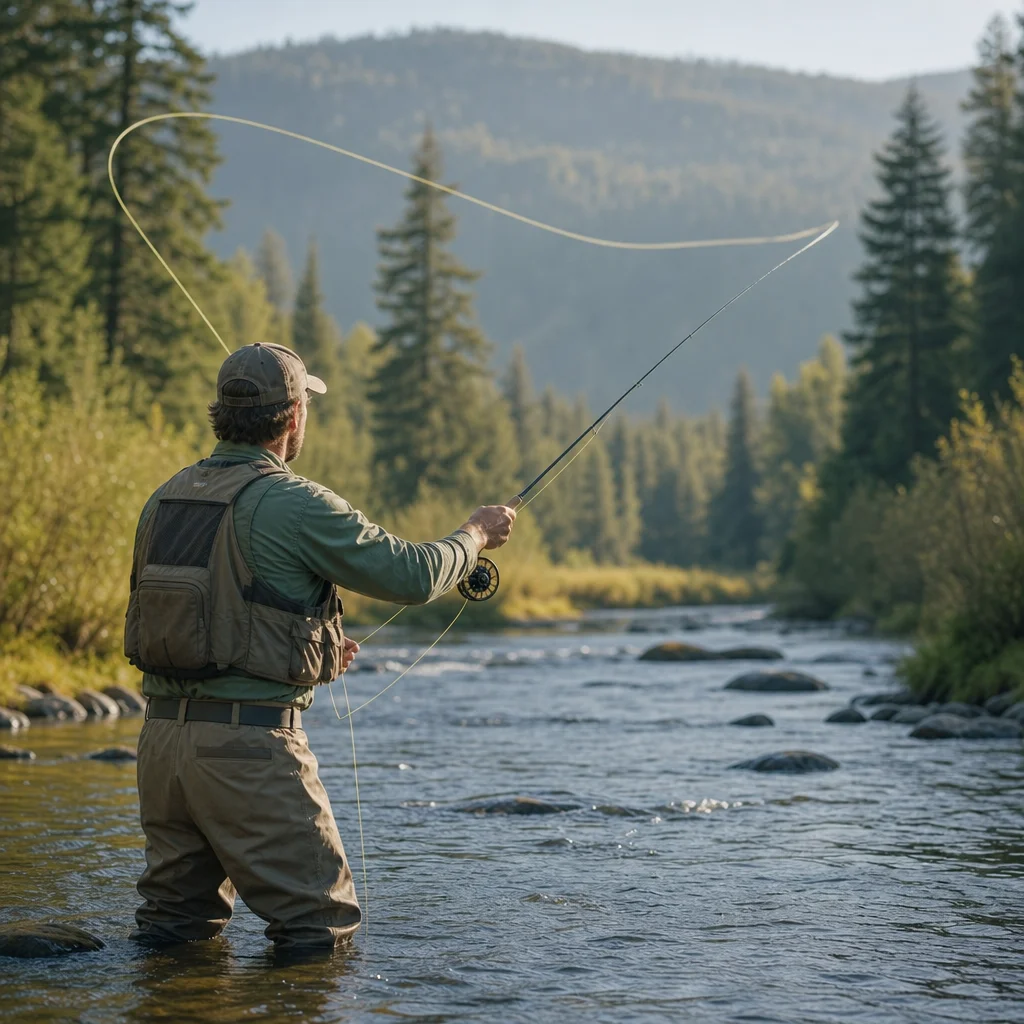
If your back cast seems to fall behind you, the problem usually isn’t a lack of strength. More often, the rod is traveling too far back, the stop comes too late, or your casting arm drifts away from a consistent path. The result is a low, delayed back loop that loses energy before the forward cast even begins.
Correcting it matters for more than distance. A back cast that travels too far behind you can send the line toward bushes, rocks, other anglers, or overhead obstacles. The safest and most efficient correction is usually smaller and simpler: track the rod on a better path, stop it crisply, and let the rod load before moving forward.
What “falling behind you” actually means
A healthy back cast travels behind your casting shoulder but remains high enough for the line to straighten above the water or ground. The rod tip moves through a controlled arc, stops, and allows the line to unroll before the forward cast begins.
When the back cast falls behind you, one or more of these things is happening:
- The rod tip continues too far backward after the stop.
- The stop is soft or delayed.
- Your arm creeps backward during the pause.
- The rod tracks in a wide, curved path instead of a compact path.
- You begin the forward cast before the back loop has straightened.
- The back cast is low because your rod angle or body position sends it toward the water.
These faults often appear together. A caster feels the back cast losing power, adds more arm movement, and makes the loop even wider. That extra effort tends to make the timing less predictable rather than fixing it.
The main causes and their corrections
1. Your stop comes too late
The stop is the moment when you stop the rod’s backward movement and allow it to bend and unload. It doesn’t need to be violent, but it does need to be distinct.
If you keep moving the rod backward after the line has begun to travel, the rod tip follows a long, low path. The line then unrolls behind you with less height and less useful energy. By the time you start forward, the line may be almost straight—or already dropping.
Correction: Use a shorter stroke and stop the rod earlier. Think of moving the rod to a firm stopping point rather than carrying it behind your shoulder. Once the stop is made, pause long enough for the back loop to form.
A useful practice rhythm is:
- Lift and move the rod backward.
- Stop firmly.
- Watch or feel the line straighten.
- Begin the forward cast.
The pause should be long enough for the line to turn over, but not so long that the line falls onto the water or ground.
2. Your arm is creeping backward
Creeping happens when your hand continues drifting backward during the pause. It often feels like you’re making room for the line, but it changes the rod position before the forward cast begins.
As the hand creeps back, the rod tip drops or the casting stroke becomes longer. You may then rush forward to catch up. That rushed movement commonly produces a weak forward loop or a tailing loop.
Correction: Finish the back cast with your hand near a repeatable stopping position. For many beginners, that position is around ear or temple height, though the exact location depends on your stance, rod, and casting style. The important point is consistency, not copying a precise body landmark.
Try holding the rod hand briefly at the stop. If the hand moves backward during the pause, shorten the stroke until you can keep it still.
3. The rod is tracking too far to the side
The rod should travel along a controlled path that gives the line room to unroll. If your casting arm swings widely behind you, the rod tip follows a large arc. A large arc tends to create a wide loop, and a wide loop takes more time and space to straighten.
This is especially common when you rotate your shoulders or let your elbow fly away from your body. The rod may appear to point far behind you, but the tip has already dropped by the time the stop occurs.
Correction: Keep the casting motion compact. Let the forearm and wrist do most of the work, with only natural movement from the elbow and shoulder. Your elbow doesn’t need to be pinned to your side, but it shouldn’t sweep dramatically backward either.
Practice with a wall, fence, or other clear visual reference well behind your casting shoulder. Keep enough distance to avoid contact. The reference can show whether the rod is traveling backward in a straight, controlled path or swinging in a large circle.
4. You’re using too much wrist
A loose wrist can allow the rod tip to dip behind you. It may also make the stop feel vague, because the hand stops while the rod continues rotating backward.
Some wrist movement is normal, but excessive wrist movement changes the rod tip’s path more than you may realize. The line follows the tip, not the position of your hand.
Correction: Keep your wrist firm enough that the rod and forearm move as a coordinated unit during the main part of the stroke. Avoid trying to create speed by snapping the wrist. Let the rod load from the line’s weight, then accelerate smoothly to the stop.
A simple drill is to cast with your thumb on top of the grip and your wrist comfortably firm. Make short false casts and focus on a clean stop rather than distance.
How to know whether the back loop is too far behind
You don’t need to see the entire loop to diagnose it. Pay attention to these signs:
- The line touches the water or ground behind you before you can cast forward.
- You feel forced to wait unusually long before beginning the forward stroke.
- The back loop opens wide and low.
- The forward cast begins with little line tension.
- The line catches vegetation or nearby objects behind you.
- Your rod hand finishes behind your normal stopping position.
If the line is straightening behind you but the cast still feels weak, the issue may be loop shape or acceleration rather than the back cast falling too far behind. If the line never straightens, you may be starting the forward cast too soon.
Check your casting space first: Before practicing a back cast, look behind, above, and beside you for people, branches, rocks, fences, and other obstacles. Keep the hook secured or use a practice fly when appropriate, and reposition rather than trying to force a back cast through a tight space.
A step-by-step correction drill
Start on open, level ground with a short amount of line outside the rod tip. You’re trying to improve the motion, not maximize distance.
Step 1: Make the stroke smaller
Begin with a short lift and back cast. Stop while your hand is still in front of or roughly beside your casting shoulder. This may feel too short at first, but it helps prevent the rod from traveling behind your body.
Step 2: Pause at the stop
After the stop, keep your hand still. Watch the line if you can do so without losing awareness of your surroundings. Let the back loop straighten before you move forward.
If the line drops, your pause was too long or the back cast was too low. If the line remains in a curved loop behind you, wait a fraction longer.
Step 3: Add a smooth forward stroke
Once the line has nearly straightened, move forward with a smooth acceleration to another firm stop. Don’t immediately add power. A compact stroke with good timing will usually produce a better loop than a long stroke with a rushed transition.
Step 4: Increase line gradually
When the short cast feels controlled, release a small amount of additional line and repeat. If the back cast begins falling behind again, return to the shorter amount of line. The extra weight may be revealing a timing problem rather than requiring more muscle.
Adjustments for wind and limited space
Wind can make a normal back cast appear worse. A headwind may slow the back cast, while a tailwind may carry it more quickly than expected. Don’t respond by automatically casting harder. First, adjust your timing and loop shape.
In a tailwind, begin the forward cast only when the back loop is ready; waiting too long can let the line collapse. In a headwind, a more compact stroke and a higher back cast may help maintain control. The best adjustment depends on the wind direction, your casting position, and the space available.
When there isn’t room for a back cast, don’t keep forcing the same motion. Change your position, roll cast, use a side cast, or choose another presentation suited to the water. A low back cast through brush is rarely an efficient solution, and it can turn a minor casting problem into a damaged leader or lost fly.
Mistakes that slow progress
Trying to fix the problem with more force
More force often makes the rod travel farther behind you and causes the stop to become less precise. Reduce the amount of line and focus on timing first.
Watching only the forward cast
The forward cast is often where the visible failure occurs, but its cause may be behind you. Watch the back loop when possible, or have a fishing partner observe your rod hand and line path.
Changing several variables at once
If you alter your grip, stance, rod angle, line length, and timing simultaneously, you won’t know which change helped. Start with the stop and hand position, then adjust one variable at a time.
Waiting until the line drops
The back loop needs time to straighten, but it shouldn’t fall. If you wait until the line is dropping behind you, the forward cast is already late. Start the forward stroke as the loop finishes unrolling, not after it has lost height.
A simple checklist on the water
Before your next cast, ask yourself:
- Is my back cast traveling on a compact path?
- Am I stopping the rod clearly?
- Does my hand stay still during the pause?
- Is the line straightening before I begin forward?
- Is my casting space clear behind and above me?
- Would a position change or roll cast be safer here?
Focus on one correction for several casts. In most cases, shortening the stroke, stopping earlier, and keeping the hand from creeping backward will bring the back cast under control. Once the loop is consistent, you can gradually add line and power without letting the rod fall behind you again.