How to Cast Around Your Own Wading Staff and Other Obstacles
I’ll compare the simplest ways to keep your wading staff, banks, brush, and awkward current from hijacking a cast. You’ll learn when to reposition, change casting direction, shorten the stroke, or use the line you already have more efficiently.
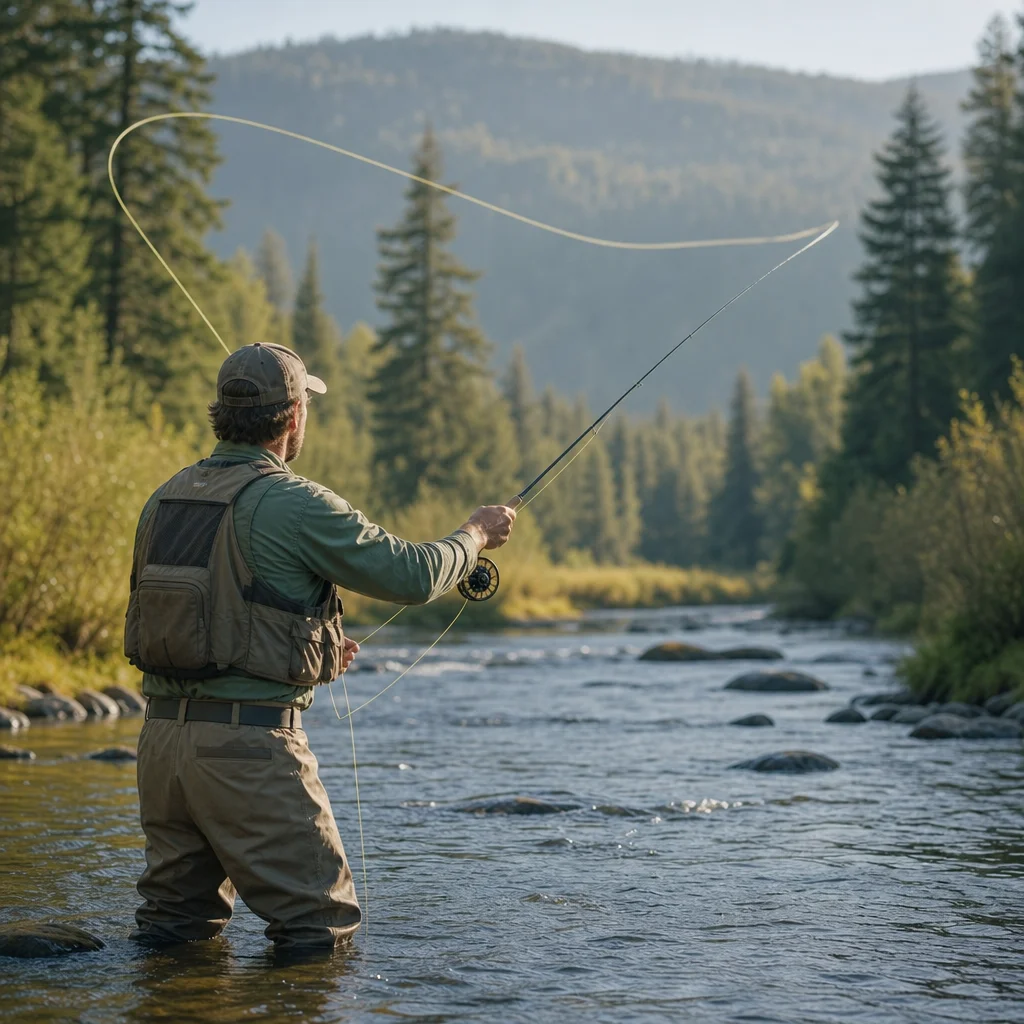
The cast that works perfectly in open water can become awkward the moment your wading staff, a steep bank, or a curtain of vegetation enters the picture. The usual overhead stroke may catch an obstacle behind you, wrap around your arm, or leave your staff in exactly the wrong place for a clean pickup.
You don’t necessarily need a specialty cast, a second rod, or more equipment. In most cases, the economical solution is to change one variable at a time: where you stand, where you hold the staff, which direction you cast, or how much line you move.
Start by identifying the obstacle
Before changing your cast, determine what is actually causing the problem. Different obstacles call for different adjustments.
- Your wading staff: It can interfere with your rod hand, shooting hand, line hand, or the loop behind you.
- Vegetation behind you: It limits the backcast and can catch the fly, leader, or running line.
- A high bank or wall: It blocks the backcast or prevents you from raising the rod normally.
- Overhanging branches: They may be above the rod tip or directly in the path of the backcast.
- Deep or fast water: It can limit your ability to step, turn, or safely reposition.
- Another angler or narrow bank: It reduces the space available for a wide casting motion.
Watch the entire casting system, not just the fly. Your rod tip, fly line, leader, staff, clothing, and nearby branches all occupy space. A cast can fail even when the fly itself appears to have plenty of clearance.
Move the staff before changing the cast
A wading staff is useful because it improves stability and helps you reach water you might otherwise avoid. It doesn’t need to remain in your casting hand or directly in front of you while you’re casting.
If you use a staff with a tether, let it hang on the side opposite your casting hand when conditions allow. Keep the handle close to your hip rather than extending it across your body. This creates a cleaner path for the rod hand and reduces the chance of the line catching the staff.
When you need both hands briefly, you have several choices:
- Plant the staff securely and keep hold of the handle. This is the most conservative option when the bottom is uneven or the current is pushing hard.
- Rest the staff against your body. Tuck it beside your forearm or hip only when you can maintain balance without gripping it.
- Use a temporary hands-free position. A properly fitted tether or holder can keep the staff close while you cast, but it shouldn’t allow the staff to swing into your legs or the current.
- Move to shallower or calmer water. Sometimes the cheapest and safest adjustment is to give up a few feet of position rather than fight the obstacle.
Don’t jam the staff into the riverbed and assume it will hold if you need it for support. Bottom type, current, depth, and the staff design all affect how secure it is. If you’re relying on it for balance, keep it in hand and make a smaller casting adjustment instead.
Change your casting direction first
The simplest way around an obstacle is often to cast away from it. This sounds obvious, but anglers commonly keep casting down the same line because the target hasn’t moved.
Suppose branches block your backcast on your right side. Rather than forcing a standard stroke, rotate your body slightly and cast toward your left. Your target may still be upstream or across the current, but the casting lane can change by several feet.
Small body-position changes matter. Try to:
- Turn your shoulders so the rod tracks through the open lane.
- Keep your casting elbow from drifting toward the obstacle.
- Face the direction of the loop rather than keeping your feet fixed downstream.
- Aim the backcast into the safest open space, not merely straight behind you.
The best casting direction is the one that gives both the backcast and forward cast room to unfold. A target may be attractive from one stance and practical from another. If moving a step or two creates a clear lane, that usually costs less line, time, and fly loss than repeated attempts from a poor position.
Use a sidearm or oval stroke in tight quarters
A sidearm cast keeps the loop lower and moves it beside you instead of directly overhead. It can help when branches, a low bank, or a bridge makes a high backcast impractical.
The main mistake is trying to cast harder. A sidearm stroke still needs a controlled pause and a reasonably straight rod path. Keep the casting hand around waist to chest height, depending on the available clearance, and direct the line through the open side.
A lower loop can be useful, but it also gives obstacles less time to get out of the way. Watch for grass, rocks, roots, and the water surface. If the line repeatedly touches the ground or water, raise the stroke slightly or reduce the amount of line outside the rod tip.
An oval, or continuous-tension, style can help when a traditional backcast would collide with something behind you. The rod travels in a slanted path, with the line moving around your body rather than stopping in a conventional backcast. This is useful for keeping the fly and leader away from brush, but it requires room to one side. It isn’t a solution if both sides are blocked.
Roll cast when the backcast has nowhere to go
When the line is already on the water and the backcast lane is blocked, a roll cast can be more efficient than trying to lift everything into the air.
Let the line settle, then bring the rod slowly into a position where the line forms a D-loop behind the rod tip. The anchored line provides the resistance needed to load the rod. Drive the forward stroke toward the target without snapping the rod or lifting the anchor prematurely.
Your wading staff can make this awkward if it crosses the path of the line hand. Move it to your noncasting side, plant it securely, or adjust your stance before forming the D-loop. Keep the rod tip high enough to clear the staff and nearby water while avoiding branches above.
A roll cast is especially useful for repositioning line, but it may not give you the same distance or line control as a clean overhead cast. Use it to make a short, accurate presentation rather than treating it as a substitute for every situation.
Shorten the cast and simplify the pickup
Many obstacle problems are caused by carrying more line than the situation requires. Extra line creates more opportunities for the fly to catch brush, the line to wrap around a staff, or the leader to land in an unintended pocket.
Strip in until you have only enough line outside the rod tip for the presentation. Then use a compact pickup with a short backcast. You may need only a few feet of line beyond the rod tip for a close target.
This approach has several advantages:
- Less line is available to snag.
- The rod requires less room to load.
- You can keep more of the line in your line hand.
- A missed cast wastes less time and distance.
- You can change direction without managing a large loop.
If the target is farther away, build distance in stages. Make a controlled false cast or two, adding line only after the current amount is stable. Don’t automatically strip everything in and start over; use the line already extended whenever it can be repositioned safely.
Manage the line hand and staff together
The line hand is often where an obstacle becomes a tangle. When you’re holding a staff, the available hand positions become limited, and loose line may fall across the handle or your wrist.
Keep the line hand close to your body and make deliberate strips. Avoid letting coils hang below your knees in moving water. If you need to switch the staff to the casting side temporarily, first secure the line in the rod hand or against the rod handle. A few seconds of organized line control is cheaper than a lost fly and a complete reset.
When changing casting hands, don’t switch while the fly is moving unpredictably. Stop or settle the line, move the staff, establish your grip, and then restart the cast. The exact sequence matters less than avoiding a rushed transfer with loose line around your feet.
Choose the safest side of the obstacle
A river feature may block the cast from one position but open a better lane from another. Before wading around it, consider whether you can solve the problem by casting from the upstream or downstream side, using the opposite bank angle, or presenting from a different current seam.
Avoid entering deeper or faster water simply to preserve a particular casting angle. A slightly less convenient presentation is usually a better trade than an unstable stance. You can often compensate with a reach cast, a mend, a shorter leader, or a more carefully placed fly.
Check your footing before changing sides: Secure the rod and line, confirm that the bottom and current are manageable, and keep your wading staff available before you reposition. A better casting lane isn’t worth an unstable step.
Match the adjustment to the problem
Use the smallest change that creates a reliable casting lane:
- Staff in the way: Move it to the noncasting side, plant it securely, or change hands before lifting line.
- Brush behind you: Use a sidearm, oval, or roll cast; shorten the line first.
- High bank behind you: Cast from the open side or use a roll cast if the line is already on the water.
- Branches overhead: Lower the casting plane and reduce the amount of line in motion.
- Narrow space on both sides: Shorten the cast, use a compact roll cast, or relocate a few feet.
- Fast or deep water: Favor stability over reach and avoid hands-free staff positions.
Practice the adjustments before you need them
You can rehearse most of these changes on grass or calm water without buying anything. Practice short sidearm casts with the rod hand at different heights. Work on roll casts with limited backcast space. Try moving the staff from one side to the other while keeping the line organized.
Also practice stopping after a snag or failed cast. Pulling hard can bury a fly in vegetation, break the leader, or bring a branch toward you. Retrieve deliberately, and if the fly is lodged, move closer only when doing so is safe.
The goal isn’t to force a perfect cast through every gap. It’s to recognize when the normal stroke is inefficient, then spend less line, less time, and less risk solving the problem. Move the staff, open the casting lane, shorten the line, and choose the cast that fits the space you actually have.
Practical next steps
On your next wading trip, carry the equipment you already use and test three adjustments in easy conditions:
- Cast from both sides of a planted staff.
- Make short sidearm casts with the line hand close to your body.
- Practice a roll cast with an intentionally blocked backcast.
- Reposition your feet before adding more casting force.
- Treat a shorter, safer presentation as a successful adjustment—not a compromise.
With those habits in place, obstacles become a positioning problem rather than a reason to buy more gear or keep repeating a cast that has no room to work.