How to Make a Controlled Roll Cast When Backcasting Room Is Limited
I’ll compare the anchor placements, rod-loading choices, and casting directions that make a controlled roll cast work beside brushy Appalachian streams, so you can choose a compact setup instead of forcing a backcast into branches.
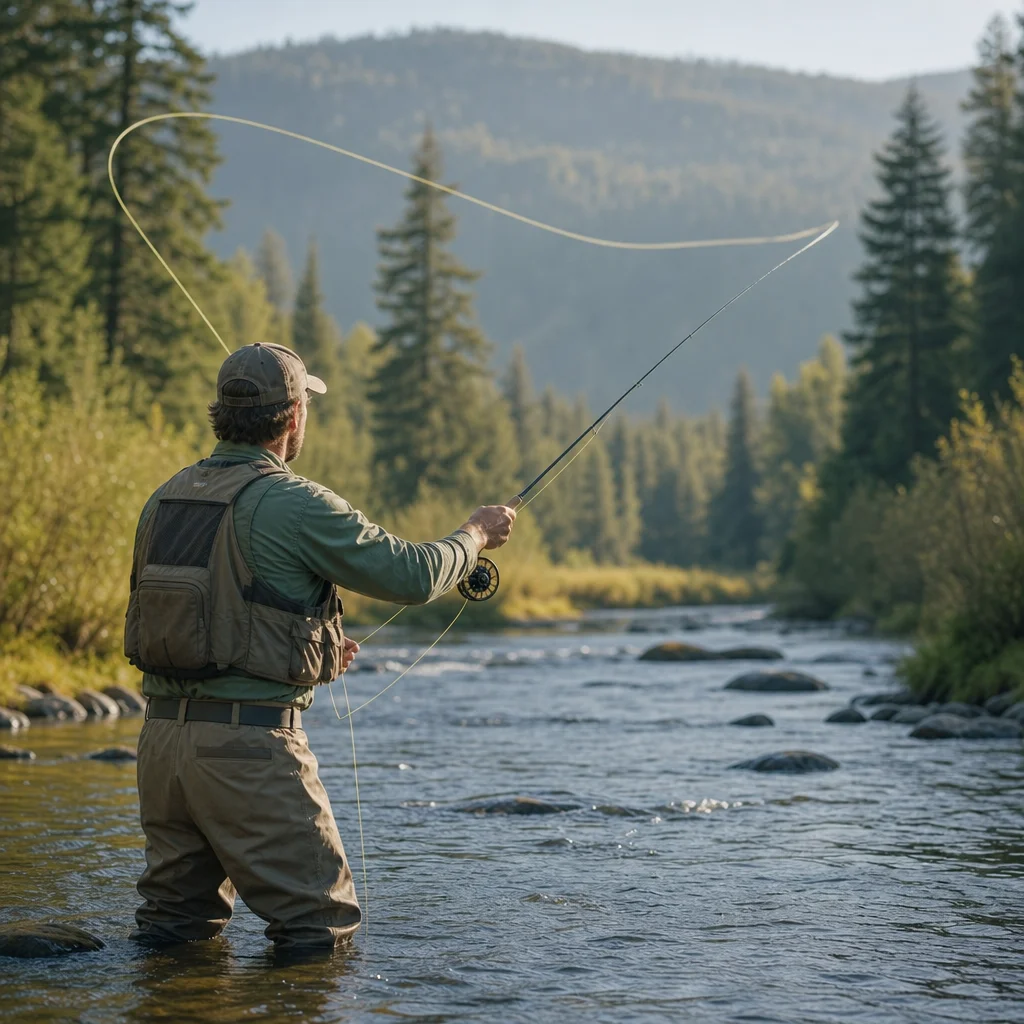
When trees, rhododendron, or a steep bank crowd your backcast, a roll cast gives you a way to reposition the fly without sending line behind you. The difficulty is that a roll cast has fewer opportunities to recover from poor timing: the anchor must land in the right place, the D-loop must form cleanly, and the forward stroke must travel in a useful direction.
On wooded Appalachian streams, you’ll often be casting from uneven banks, shallow runs, or narrow pockets where the current and vegetation limit your options. A controlled roll cast is less about making a large loop and more about managing the small amount of space you have.
What makes a roll cast controlled
A roll cast uses the water’s surface to anchor part of the fly line while the rod creates a D-loop behind you. When you drive the rod forward, the loop unrolls toward the target and pulls the anchored line from the water.
The cast has three jobs:
- Place the anchor close enough to the rod tip to grip the water, but not so close that it tangles.
- Build a compact D-loop behind the rod without letting the line touch branches, grass, or the bank.
- Send the forward stroke in a straight path toward the target.
Most failed roll casts come from one of those jobs being rushed. Anglers often compensate by using more force, but extra force rarely fixes a misplaced anchor or a collapsing loop.
A useful mental model is to treat the line on the water as a brake. You need enough contact to load the rod, but not so much line stuck to the surface that the cast becomes heavy and wide.
Start with the rod, line, and target direction
Before moving the rod, decide where the line needs to go. Your target might be a pocket beneath an overhanging branch, the inside edge of a current seam, or a short drift upstream. The forward stroke should point toward that target, not simply toward the open water.
If possible, stand so your casting shoulder has the clearest route. For a right-handed caster, a target slightly to the right may allow a more comfortable forward stroke, while a target on the left may require a side roll or a change in stance. Don’t force every cast into a vertical plane. The best rod path is the one that avoids the obstruction and still allows the line to unroll.
Keep only the amount of line outside the rod tip that you can control. A beginner often carries too much line because a longer cast feels more productive. In tight water, excess line makes anchor placement less precise and increases the chance of catching brush.
Step 1: Lift and position the line
Begin with the fly and leader in front of you, usually on the water or just above it. Raise the rod smoothly, bringing the line toward the side you’ve chosen for the D-loop.
The lift should be deliberate rather than abrupt. You’re separating the line from the surface and arranging it behind the rod. If you snatch the rod upward, the line can jump into a loose pile, stick to nearby vegetation, or leave the fly in an unpredictable location.
As the rod moves back, stop when the line has formed a compact shape behind you. You don’t need a dramatic sweep. In a confined stream corridor, a small D-loop is usually safer and easier to control than a broad one.
Keep your casting hand and rod tip away from the branches. The rod tip should move on a path that gives the line room to follow. A high rod position may clear low grass but put the D-loop into overhead limbs, while a lower side cast may solve the same problem.
Step 2: Place the anchor deliberately
The anchor is the portion of leader and fly line that touches the water before the forward stroke. Its position determines how efficiently the rod loads.
For a standard controlled roll cast, place the anchor slightly to the casting side and in front of you. It should be close enough to the rod tip that the line forms a compact connection, but far enough away that the leader and fly don’t pile directly at your feet.
A good anchor usually looks like a small, tidy contact point rather than a large splash or a loop of line spread across the surface. The fly shouldn't be whipping around behind you as you prepare the cast. If it is, pause and let the line settle or shorten the lift.
Anchor placement in different water
- Slow water: The line may stick more readily, so use a smaller anchor and a smooth lift. Too much line on the surface can make the forward stroke feel sluggish.
- Fast water: The current can pull the anchor downstream before you cast. Place it with the current in mind, and make the transition from lift to forward stroke promptly.
- Broken or pocket water: Bubbles, rocks, and conflicting currents can interrupt the anchor. Use a shorter line and aim for the calmest available patch of surface.
- Shallow water: Keep the fly and leader moving in a controlled path. A short anchor is preferable to dragging the fly across several feet of bottom.
If the anchor lands behind you, the cast will tend to pull sideways or collapse. If it lands too far in front, the D-loop becomes long and weak. If it lands directly beside your body, you may have little room to form a useful loop.
Step 3: Form the D-loop without overworking it
Once the anchor is placed, move the rod smoothly backward and slightly upward until the line behind the rod forms a D-shape. The straight portion of the line on the water is one side of the system; the curved line behind the rod is the other.
The D-loop needs room to form, but that room may be only a narrow strip beside the stream. Keep the loop compact by using a short stroke and stopping the rod firmly enough to let it load. A slow, continuous drift often allows the line to fall behind you instead of forming a crisp loop.
The rod tip should travel on a path that matches the direction of the eventual forward cast. If you plan to cast across the stream, form the D-loop on the side that lets the forward stroke travel across it. If the rod tip moves in one direction and the anchor sits in another, the loop will carry that mismatch into the cast.
Don’t begin the forward stroke while the line is still falling into position. Wait for the anchor to grip and the rod to load. This pause may be brief, but it matters. In a controlled cast, the pause is part of the cast rather than wasted time.
Step 4: Drive the forward stroke
Start the forward stroke with a firm, progressive movement. The hand should move forward and slightly upward, with the rod tip traveling toward the target. Finish with a clear stop rather than pushing the rod continuously toward the water.
The stop allows the rod to unload and the loop to turn over. If you stop too low, the line may slap the water early. If you stop too high, the loop can open and drift above the target. Adjust the rod angle to the space available and the height of the target.
Think of the forward stroke as sending the loop through the target, not throwing the fly at it. The line should unroll in front of you with a narrow, stable loop. After the turnover, lower the rod tip and allow the fly to settle naturally.
Power should be the final adjustment, not the first. A smooth stroke with a clean anchor generally outperforms a hard stroke that tears the anchor loose.
Choosing the casting direction
Casting direction is one of the most useful advanced choices when the bank is crowded. You can often change the usable space by moving the D-loop to a different side of the rod.
Cast toward the open bank
If one side of the stream has more airspace, form the D-loop there and cast toward the tighter bank. This keeps the loop away from branches and directs the fly beneath cover.
The trade-off is that your body may block the forward stroke if you stand too squarely to the target. Turn your shoulders and use a side angle rather than reaching around yourself.
Cast across the current
A cross-stream roll cast can place the fly into a pocket that is difficult to reach with a conventional cast. Keep the line short enough that the current doesn’t pull the anchor downstream before the stroke begins.
A strong cross-stream current may also pull the fly and leader into a curved shape. If that happens, reduce the amount of line outside the rod tip and cast sooner after the anchor settles.
Cast upstream or downstream
An upstream roll cast may give you a better drift, but the current can move the anchor and fly toward you. Keep the cast compact and avoid allowing slack to gather at your feet.
A downstream cast can be easier to load when the current helps hold the line, but it may produce an unnatural presentation if the fly lands too quickly or drags. Use the direction that solves the immediate obstruction while preserving the drift you want.
Common problems and corrections
The line piles up in front
The forward stroke may be too low, too slow, or directed away from the target. Raise the rod path slightly, tighten the anchor, and stop the rod more decisively.
The anchor breaks loose
This usually means the stroke began before the line was set, or the forward movement was too abrupt. Shorten the line and wait for the anchor to grip before applying power.
The cast travels sideways
The anchor and rod path are probably misaligned. Place the anchor in the same general direction as the intended forward stroke, then form the D-loop directly behind that path.
The fly catches branches behind you
Your D-loop is too large, too high, or on the wrong side. Reduce the line length, lower the rod angle, or switch to a side roll that keeps the loop in the open corridor.
The line lands in a heap
A collapsed D-loop, a weak stop, or too much line on the water can cause this. Start with less line and make the forward stroke smooth but definite. A tidy short cast is more useful than a long failed one.
The fly moves too far during setup
The fly may be drifting with the current while you organize the cast. Shorten the line, make the lift more continuous, and avoid repeated false movements. In tight water, every extra motion is another chance for the fly to find a branch.
When a roll cast isn’t the best option
A roll cast needs some room in front of you. If the target is immediately beside your rod tip, the water is too turbulent to hold an anchor, or the fly is trapped in weeds, another compact method may be more suitable. You might first need to hand-strip the line free, reposition your feet, or move to a clearer bank.
A roll cast also isn’t a substitute for correcting a poor approach. If you’re standing too close to the pocket, the cast may place the fly well but still spook fish. Take the time to choose the casting lane before you start moving the line.
A compact practice sequence
You can practice the motion without trying to reach a distant target:
- Hold a short length of line outside the rod tip.
- Lift the line smoothly to one side.
- Place a small anchor in front and slightly to the casting side.
- Form a compact D-loop behind the rod.
- Pause briefly for the anchor to grip.
- Drive the rod forward toward a specific target.
- Watch the loop rather than the fly.
Once the loop unrolls cleanly, add line in small increments. Practice changing the D-loop from one side of the rod to the other, since real stream banks rarely offer the same casting lane twice.
Final checklist for the stream
Before making the cast, ask yourself:
- Where can the D-loop safely form?
- Where do I want the line and fly to land?
- Is the anchor small, clean, and aligned with that target?
- Has the line settled enough to load the rod?
- Can I use a shorter stroke instead of more force?
A controlled roll cast is a sequence of small decisions: choose the open side, place the anchor, form the loop, pause, and drive the line toward the target. In brushy Appalachian water, that discipline lets you cast around the landscape instead of fighting it. Start with short line, make the loop predictable, and add distance only after the cast remains controlled.