How to Practice Holding a Fly Rod Before You Reach the Water
Many new anglers feel awkward holding a fly rod, managing loose line, and making the first casting motions. I’ll show you how to practice grip, stance, line control, and pickup-and-laydown movements in a safe open space before you reach the water.
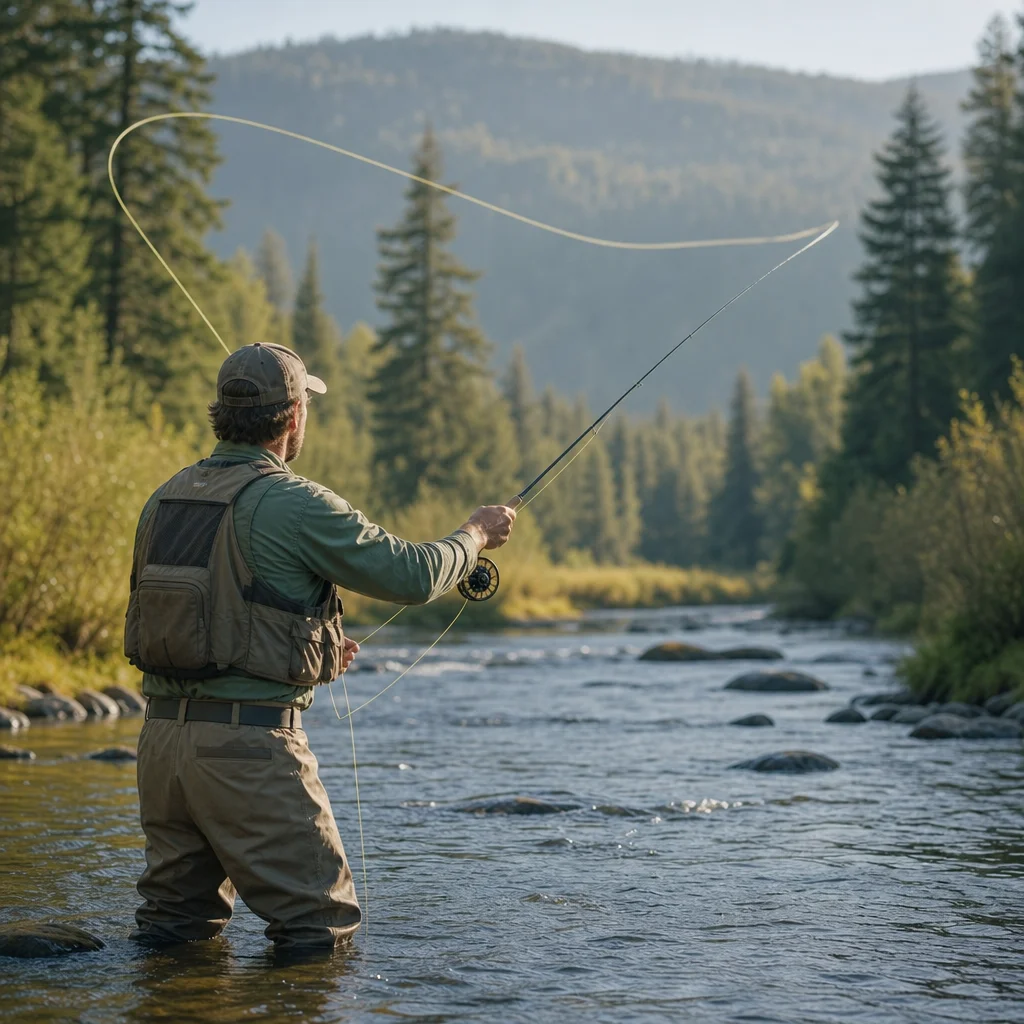
The first few minutes with a fly rod can feel surprisingly busy. You’re balancing the rod, watching the line, trying not to grip too tightly, and wondering whether your arm is supposed to move from the shoulder, elbow, or wrist. Practicing at home or in a yard won’t replace time on the water, but it can make those first sessions calmer and more productive.
You don’t need a long cast or a complicated drill. Start by learning how the rod should feel in your hand, how your body supports the motion, and how to keep line from becoming a loose pile around your feet.
Set up a simple practice space
Choose an open area with enough room to move the rod without touching furniture, branches, vehicles, people, or pets. A backyard, quiet park, empty field, or spacious gym can work well. Indoors, a rod-length space may be enough for handling practice, but it usually isn’t suitable for moving line.
For early drills, you can practice with the rod assembled but without a fly. Remove the leader and fly if you’re working indoors or around other people. A short piece of brightly colored yarn tied to the end of the leader can give you something visible to track during basic outdoor movements. Keep the yarn light enough that it doesn’t load the rod like a real fly line.
Clear the practice zone: Before you start moving line, check above, beside, and behind you for branches, wires, furniture, and anyone who could step into the rod’s path. Keep the hook off the setup until you’re practicing at the water or in a properly controlled casting area.
Start with five or ten quiet minutes. The purpose is to build familiarity, not to force a full casting session before breakfast.
Find a relaxed grip
Hold the rod handle as if you were shaking hands with it. For most standard fly rods, your thumb rests on top of the grip, with your fingers wrapped comfortably underneath. Your hand should control the rod without squeezing it hard.
A grip that’s too tight creates several problems:
- Your forearm tires quickly.
- The rod feels stiff and difficult to move smoothly.
- You’re more likely to use your wrist excessively.
- Small changes in direction become abrupt.
A grip that’s too loose can also be a problem. The rod may shift in your hand, especially when you stop it or change direction. Aim for secure but relaxed. Every so often, briefly loosen your fingers to notice whether you’ve started clenching.
Keep your casting hand near the end of the handle rather than reaching up the blank. The handle is designed to give you control while allowing the rod to flex above your hand. Your other hand can manage the line, but it doesn’t need to grip the rod.
Practice a balanced stance
Stand with your feet about shoulder-width apart. Place one foot slightly ahead of the other, with your knees relaxed rather than locked. You don’t need a dramatic athletic stance. You need a position that lets you turn slightly and stay comfortable for several minutes.
Keep your shoulders loose and let your casting arm hang naturally. The rod should point generally forward, not straight at the ground and not high above your head. Look toward an imaginary target in front of you, then turn your eyes to the rod and line when a drill requires it.
Your stance should support the motion without becoming the motion. Beginners sometimes lean backward during the backcast or step forward during the forward stroke. Practice staying balanced while your arm makes small, controlled movements.
Learn the line hand’s job
The line hand controls the loose line between the rod and your body. It may seem secondary at first, but it helps you keep line organized and later allows you to adjust distance and manage tension.
Hold the line lightly between the thumb and the first finger of your casting hand or line hand, depending on the technique you’re learning. Let the line hand make small, deliberate movements rather than large pulls.
Try this stationary drill:
- Hold the rod forward with your casting hand.
- Let a short length of line or yarn extend beyond the rod tip.
- Pinch the line lightly with your line hand.
- Move the line hand a few inches toward your body, then return it.
- Keep the rod hand still and notice how the line changes position.
The goal isn’t to create a cast. It’s to learn that the rod hand and line hand have different jobs. The rod hand guides the rod. The line hand manages slack and tension.
Begin with pickup-and-laydown motions
A pickup-and-laydown cast is a useful first movement because it avoids the complexity of keeping line moving through the air. You lift line from the ground or water, make one controlled backcast, and place it forward again.
On dry ground, use only a short amount of line. Lay it out in front of you, with the rod tip low enough to keep the line within reach. Start with the rod tip pointing toward the line.
Then work through this sequence:
- Keep your line hand steady and your grip relaxed.
- Move the rod smoothly upward and slightly backward.
- Pause when the rod points behind you and the line has lifted.
- Bring the rod forward in a controlled motion.
- Stop the rod with the tip pointed toward your target.
- Allow the line to settle in front of you.
The stop matters. If you continue the rod forward without a clear stop, the line often drops in a heap. If you stop too abruptly with a tense arm, the movement becomes jerky. Think of moving the rod and then allowing the line to travel, rather than trying to push the line all the way to the target.
At first, the backcast can be short and modest. You’re learning the order of events: lift, pause, move forward, stop, and let the line settle.
Use a clock-face reference without becoming rigid
Instructors often describe rod positions using a clock face. A rod held straight overhead is near 12 o’clock; a rod angled behind you may be near 1 or 2 o’clock, depending on how you’re facing and how the technique is described.
This reference can help you understand direction, but don’t treat the numbers as exact targets. Your best stopping point depends on the amount of line, the rod, and the space around you. The important habit is to move the rod in a straight path and stop before it drifts too far backward or forward.
Practice slowly enough to notice the rod tip. If the tip travels in a wide, curved loop, reduce the size of the motion. A smaller movement with a clear stop is more useful than a large movement that feels impressive but leaves the line tangled.
Add line only after the motion feels familiar
Once you can repeat a short pickup-and-laydown movement without losing your balance or tangling the line, add a little more line. Increase it gradually rather than pulling out all the fly line at once.
After each increase, ask three questions:
- Can I keep the line off my feet?
- Can I pause long enough to let the backcast straighten?
- Can I stop the rod without tightening my entire arm?
If the answer to any question is no, shorten the line and return to the previous step. More line increases the timing challenge. It doesn’t automatically improve practice.
You can also mark a few targets on the ground with small cones, towels, or leaves. Place them at different distances and practice laying the line near each one. Avoid turning this into a contest. Accuracy comes from repeatable movement, not from rushing toward the farthest target.
Common practice mistakes
Gripping the rod too tightly
If your knuckles turn white or your forearm feels tired after a few minutes, relax your hand. Shake it out and restart with smaller movements.
Moving the wrist too much
Some wrist movement is natural, but a floppy wrist makes the rod tip wander. Keep the wrist comfortable and let the forearm and elbow contribute to the motion. You’re aiming for control, not stiffness.
Casting with the whole body
A little rotation can help, but leaning, lunging, and stepping usually make the motion harder to repeat. Keep your feet planted during the first drills and let the rod do the work.
Starting with too much line
A long length of line magnifies timing errors. Begin with enough line to see what’s happening, then add more only when the shorter movement is consistent.
Watching only the target
Look at the target when you begin the forward motion, but occasionally watch the line and rod tip. You need to learn what a straightening backcast looks like and how the line behaves when your timing is early or late.
A short practice routine
A ten-minute routine is enough to build useful familiarity:
- One minute: Hold the rod, relax your grip, and find a balanced stance.
- Two minutes: Practice keeping a short length of line organized with the line hand.
- Three minutes: Repeat pickup-and-laydown motions with a short line.
- Two minutes: Add a little line and practice pausing on the backcast.
- Two minutes: Lay the line near simple targets without trying to maximize distance.
Stop if your arm becomes tired or your movements turn tense. Short, focused practice is more valuable than repeating a poor motion until it feels normal.
Take this preparation to the water
Before your first fishing session, you don’t need to be able to cast across a river. You’ll be better prepared if you can hold the rod comfortably, maintain a relaxed stance, keep loose line under control, and perform a simple pickup-and-laydown movement without panic.
At the water, begin with less line than you think you need. Identify the space behind you, watch for obstacles, and repeat the small motion you practiced. As the rod and line start to feel familiar, you can gradually work on distance, accuracy, and different casting situations.
The most useful preparation is deliberately ordinary: relaxed hand, balanced feet, organized line, smooth lift, clear pause, controlled forward movement, and a calm stop. Those basics give you something dependable to return to when the trout, wind, or river has other ideas.