A First Fly-Fishing Lesson for Left-Handed Anglers
Left-handed beginners often get handed right-handed casting advice that makes rod control and line management feel awkward. I’ll explain which choices matter, which can stay flexible, and how to build a first lesson around your natural movement rather than correcting it.
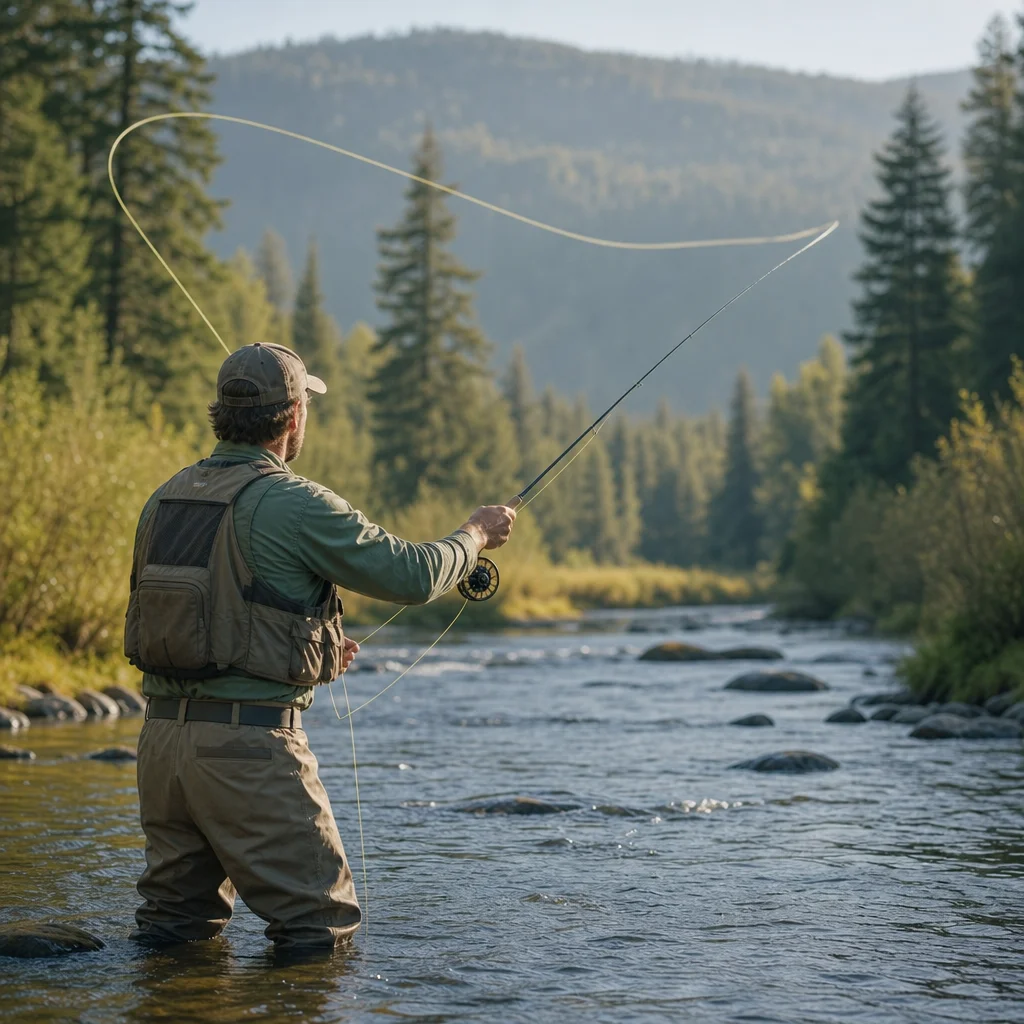
Your first fly-fishing lesson can become confusing when the instructor stands on your casting side, demonstrates with the opposite hand, and assumes the “usual” setup will feel natural. You don’t need to overcome being left-handed. You need clear choices about which hand controls the rod, where the line travels, and how much space you have to cast safely.
The goal of a first lesson isn’t a beautiful loop or a long cast. It’s learning a repeatable motion without tangling yourself, crowding another angler, or changing several variables at once. Start with the setup that feels coordinated, then make small adjustments as you learn.
Start with the hand that controls the rod
For most left-handed beginners, the simplest starting point is to hold the rod in your left hand. Your left hand controls the rod grip and casting motion, while your right hand manages the loose line near the reel. This arrangement lets each hand perform one clear job.
That doesn’t make it the only correct arrangement. Some anglers prefer to cast with their right hand because of previous sports, injury, strength, or habit. Others switch hands when casting from the opposite bank or when a strong wind makes one side more convenient. You can explore those options later, but using your more coordinated hand for the rod usually makes the first lesson easier to understand.
Ask your instructor to demonstrate the movement from your viewpoint or to mirror the demonstration. A right-handed demonstration can look reversed when you try to copy it. The important details are the direction of the rod, the timing of the pauses, and the path of the line—not whether your hands match the instructor’s.
Don’t confuse reel orientation with casting-hand choice
A fly reel is usually mounted beneath the rod, and many models allow the retrieve handle to be changed from one side to the other. That adjustment affects which hand turns the reel handle. It doesn’t require you to cast with the same hand that retrieves line.
For a common left-handed setup, you might cast with your left hand and retrieve with your left hand after switching the reel’s retrieve direction. Some anglers instead cast left-handed and retrieve with the right hand, especially if they prefer not to change hands after a hook-set or while fighting a fish. Either arrangement can work.
For your first lesson, don’t let reel-handle preference distract from learning the cast. Confirm that the reel retrieves in the direction you expect, make sure the line exits smoothly, and focus on rod control. You can refine the arrangement once you know what feels natural.
Keep the line hand simple
The hand not holding the rod manages the fly line. It controls how much line is outside the rod tip and helps you carry, release, or strip line during a cast.
Beginners often make line management harder by gripping too much line or allowing several loops to fall around their feet. Hold the line lightly with the fingers of your right hand, usually against the rod grip or index finger area, and keep only a manageable amount of loose line outside the rod tip while you practise. Your instructor can show you the exact finger position for the rod and line setup you’re using.
The line hand doesn’t need to move dramatically during a basic cast. First learn to:
- Keep the rod hand relaxed.
- Let the line hand hold the line without squeezing it.
- Lift enough line from the ground or water to begin the cast.
- Pause as the line straightens behind you.
- Move the rod forward smoothly.
- Release or feed line only when your instructor asks you to.
A common left-handed beginner’s mistake is trying to copy the instructor’s line-hand movement with the same hand. Mirror the function, not the side. If the instructor’s non-rod hand holds the line, your non-rod hand should hold the line too—even if it’s the opposite hand.
Give your backcast room
Your casting direction matters more than your handedness when you’re choosing a safe practice position. If you hold the rod in your left hand, you may naturally cast toward your left side. That can be useful in open space, but it may place the backcast close to a bank, tree, fence, or another person depending on how you’re standing.
Before lifting the line, look behind and to both sides. Check for branches, tall grass, people, pets, and anything that can catch a hook. Don’t assume that a clear space in front of you means the backcast is clear. The fly travels behind you during part of the motion, and a beginner’s cast may spread farther sideways than expected.
If the area is crowded on your left, you have several choices:
- Turn your stance so the casting plane points into open water or open ground.
- Move to a position with more room behind you.
- Learn a roll cast, which keeps the line mostly in front of you.
- Ask your instructor to adjust the lesson position rather than forcing an awkward angle.
You don’t have to cast from a perfectly square stance. Your feet can be comfortable and slightly open, with your shoulders relaxed. The better position is the one that gives your rod arm a clear path and keeps the hook away from people and obstacles.
Check your casting lane: Before each practice sequence, confirm that the area behind and beside your left casting shoulder is clear, then tell your instructor where you want the demonstration and your own casting space to be.
Adapt the instruction, not your natural movement
A good lesson should give you a reference point that works for your body. If the instructor says “stop at one o’clock,” ask which direction that means from your stance and whether the example is being mirrored. Clock positions can be useful, but they’re easy to misunderstand when the teacher and student cast with opposite hands.
It may be clearer to use physical descriptions:
- “Lift the rod smoothly toward your back shoulder.”
- “Pause until the line straightens behind you.”
- “Move forward toward the target.”
- “Keep the casting motion on this side of your body.”
Ask the instructor to watch your rod tip and line rather than trying to make your hands look identical to theirs. The rod should load and unload through a controlled movement. Excessive wrist movement, abrupt stops, and trying to cast too much line are common beginner problems for anglers of every handedness.
If the demonstration remains confusing, stand behind the instructor and watch the motion from the same general orientation, or ask for a slow, mirrored demonstration. There’s no prize for silently translating a reversed lesson in your head.
Learn one cast before adding alternatives
The overhead cast is a useful first exercise when you have enough open space. It teaches the basic rhythm of lifting the line, pausing during the backcast, and moving forward without rushing. Start with a short amount of line and concentrate on straightening the line rather than distance.
A roll cast is especially valuable when trees, steep banks, or other obstacles limit your backcast. It also introduces a different line-loading motion. However, it can add another set of instructions to your first lesson, so learn it after you understand the basic rod movement unless your fishing spot makes an overhead cast impractical.
You may also hear about switching hands to cast from the other side. That can be helpful when wind, brush, or your position on a stream makes the left-handed casting lane inconvenient. Treat it as a later skill. Changing hands while still learning timing can create more confusion than it solves.
Prevent the most common first-lesson tangles
A few habits keep practice productive:
- Don’t start with too much line. More line increases the number of things that can tangle.
- Don’t watch only the rod tip. Track the line’s direction and listen for your instructor’s timing cues.
- Don’t grip the rod tightly. Tension makes smooth acceleration difficult.
- Don’t cast harder when the line fails to straighten. Check your timing, pause, and rod path first.
- Don’t step backward without looking. Your backcast space may be clear while your feet aren't.
- Don’t change rod hand, reel direction, stance, and casting style at once. Adjust one variable, then test it.
If the line piles up in front of you, you may be moving forward before the backcast has straightened. If it falls behind you, you may be rushing the forward motion or stopping the rod too low. Have the instructor identify the pattern before you try to correct it with more force.
Leave the lesson with a simple routine
Before you finish, practise a short sequence you can repeat on your own:
- Choose a clear casting lane.
- Hold the rod in the hand that gives you the best control.
- Keep the line hand relaxed and organized.
- Start with a short amount of line.
- Lift, pause, and move forward smoothly.
- Stop when your timing deteriorates instead of adding effort.
Your first setup doesn’t have to be permanent. You can later test a different retrieve hand, practise casting from the opposite side, or learn techniques for tight spaces and wind. For now, the best arrangement is the one that lets you understand the motion, keep the line under control, and practise without treating your left-handedness as a defect.
Take that routine to an open practice area, repeat it slowly, and change only one detail at a time. A comfortable left-handed cast is built through clear feedback and repetition—not by forcing yourself to imitate a right-handed angler exactly.